


This is your weekly Animenomics briefing, covering the business of anime and manga. Today is Wednesday, November 4, 2026.
An announcement: Animenomics was named by jurors at the Los Angeles Press Club as a finalist in the 19th National Arts and Entertainment Journalism Awards.
Animenomics is nominated alongside news outlets Bloomberg News, TheWrap, Variety, and Business Insider in the Business, Tech/Design/Arts (Online), category for a September 2025 article on Japanese amusement giant Genda’s efforts to consolidate more than 13,000 arcade machine locations across North America.
It’s the second year in a row that Animenomics has been named a finalist in these awards.
Anime revenues abroad slow as domestic sales rebound
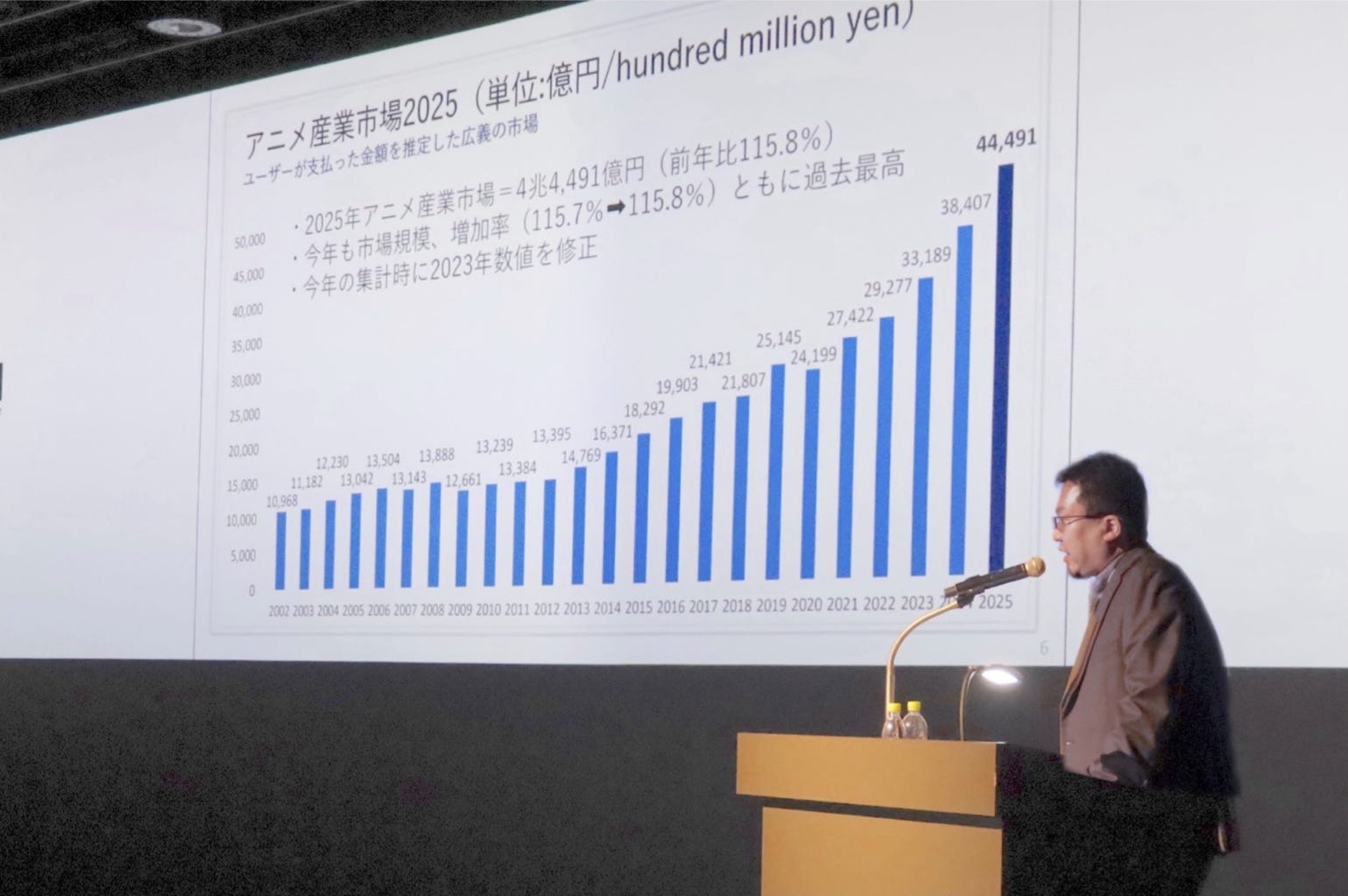
Growth in the overseas revenues of Japan’s anime industry cooled in 2025 compared to the previous year but remained strong, climbing 17 percent, the fourth consecutive year of double-digit growth, according to the Association of Japanese Animations.
Why it matters: Inconsistent growth in anime’s overseas market raises the question of whether the industry can meet the government’s target of ¥6 trillion (US$38 billion) in anime exports by 2033.
By the numbers: Anime’s consumer market outside Japan was ¥2.54 trillion (US$16.1 billion) in 2025, accounting for about 57 percent of the global anime market.
On the other hand, Japan’s domestic anime market expanded at its fastest rate in four years, surging 14 percent to ¥1.91 trillion (US$12.1 billion).
Combined, the global anime market averaged a growth rate of 15.8 percent year-over-year, roughly the same as last year.
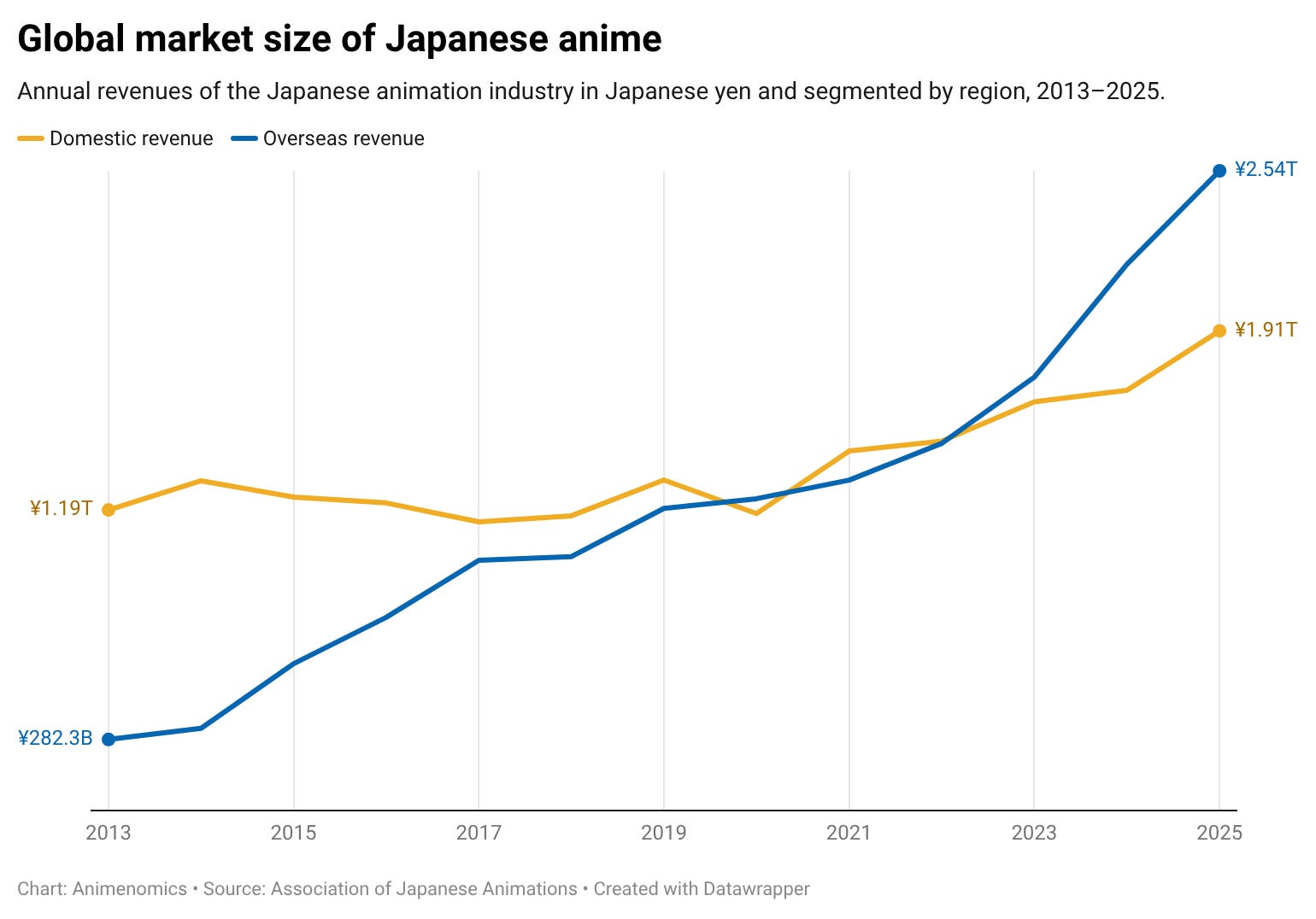
Between the lines: Studios and production companies that make anime saw revenue growth of 8.4 percent, lower than last year and slower than the broader market that includes sales of merchandise and other derivative services.
While the proportion of overseas revenue at anime studios rose by more than two points to 28 percent, thanks to a historically weak yen, studios still aren’t receiving enough windfall from consumers abroad.
Only 5.5 percent of overseas anime sales trickle down to Japanese studios, a rate much lower than other Japanese entertainment industries—92 percent for games, 22 percent for live-action films, and 8 percent for publishing—according to data compiled for the Ministry of Economy, Trade, and Industry’s 2026 strategy.
What they’re saying: To accelerate growth overseas, the anime industry must move to build out its business infrastructure abroad to catch up to a robust domestic infrastructure, Masahiro Hasegawa, one of the report’s authors said in a presentation at the Tokyo International Film Festival Content Market last week.
What we’re watching: A more detailed breakdown of the numbers will be available in early December with the publication of the AJA’s annual Anime Industry Report.
Nippon Anime Awards seeks to honor anime creators

Japan’s anime industry is organizing the inaugural Nippon Anime Awards to be held in November 2027 with the support of the Tokyo Metropolitan Government, replacing the Tokyo Anime Award Festival that ended a 13-year run in March.
Why it matters: The Nippon Anime Awards aims to direct anime’s newfound global attention toward Japan’s anime creators, who often don’t see the windfall of growing revenues from anime’s overseas expansion.
How it happened: In early discussions with Tokyo Anime Award Festival organizers, anime studios indicated that they would like more recognition for individual creators, A-1 Pictures chief executive officer Akira Shimizu told a panel audience of the Tokyo International Film Festival Content Market.
Tokyo Anime Award Festival, which was spun off from the now-defunct Tokyo International Anime Fair in 2014, did not have a specific focus on Japan’s anime industry and often feature foreign animated films.
However, as anime grew in popularity outside Japan, anime streaming platform Crunchyroll in the United States expanded the scale of its anime awards event, often raising eyebrows with its selection of awardees.
With the Nippon Anime Awards focused on recognition by domestic industry figures, Shimizu hopes the awards will spark interest in young talent to join the anime industry.
The bigger picture: Japan sees prestigious awards as a way to raise not only anime’s artistic value but also commercial value at home and abroad.
One show the Nippon Anime Awards could model itself after is the annual Music Awards Japan, which was inaugurated last year by the music industry with support from the Ministry of Economy, Trade, and Industry.
Just like how Music Awards Japan sought to replicate the prestige of the Grammy Awards in the U.S., the Nippon Anime Awards could look to the Academy Awards as an example, Studio Chizu chief executive officer Yuichiro Saito said during the TIFFCOM panel.
Clippings: FuRyu moves into Japan capsule toy market

Tokyo-based FuRyu, a maker of print stickers and anime figurines, will form a capsule toy business next month, targeting female consumers and annual sales of ¥5 billion (US$32 million) by March 2031. (Nikkei)
Japan’s domestic capsule toy market jumped 39 percent year-over-year in the twelve months ending in March, reaching ¥196 billion (US$1.24 billion), according to data compiled by the Japan Capsule Toy Association.
Toei Animation reported a 3.7 percent growth in second quarter net sales for the three months ended in September, but operating profit and net profit fell more than 8 percent as it directs funds to new investments. (Gamebiz)
After announcing plans to open new animation studios in Southeast Asia last year, Toei Animation has begun recruiting key animation and production roles in Vietnam through Facebook.
CyberAgent-owned Colorful Palette, the mobile game studio behind Hatsune Miku: Colorful Stage!, which was adapted into a niche box office hit film last year, formed an anime studio named Latent One. (Press release)
Anime music (anisong) singers are seeing work dry up as many anime series move to use voice actors and J-pop artists as theme song performers, forcing some to add voice acting to their work portfolio. (Otaku Lab)
Former Jump+ manga editor launches indie publisher
“We fully intend to become a publisher. We will create our own manga app, develop numerous new works, and carefully train young authors. My simple wish is that Mix Green will become, over the next ten or twenty years, a place where good works and good authors are born.”
— Shihei Lin, Spy × Family, Chainsaw Man, and Dandadan manga editor
Context: In an interview with French news website L’Internaute, Lin, a veteran editor formerly with manga publishing giant Shueisha’s Shonen Jump+ digital platform, outlined plans for new digital manga development at his newly formed independent publishing house.
Catch up quick: Lin, who has worked in an outsourced capacity with Shueisha since he left the company in 2022, was in the spotlight last month after the publisher said that it was ending its working relationship with him and his company.
What he’s saying: By leaving Shueisha, Lin wanted to maintain direct relationships with manga artists as their frontline editors rather than rising through the company ranks into management and corporate roles.
1 chart to go: Availability of boys’ love manga grows
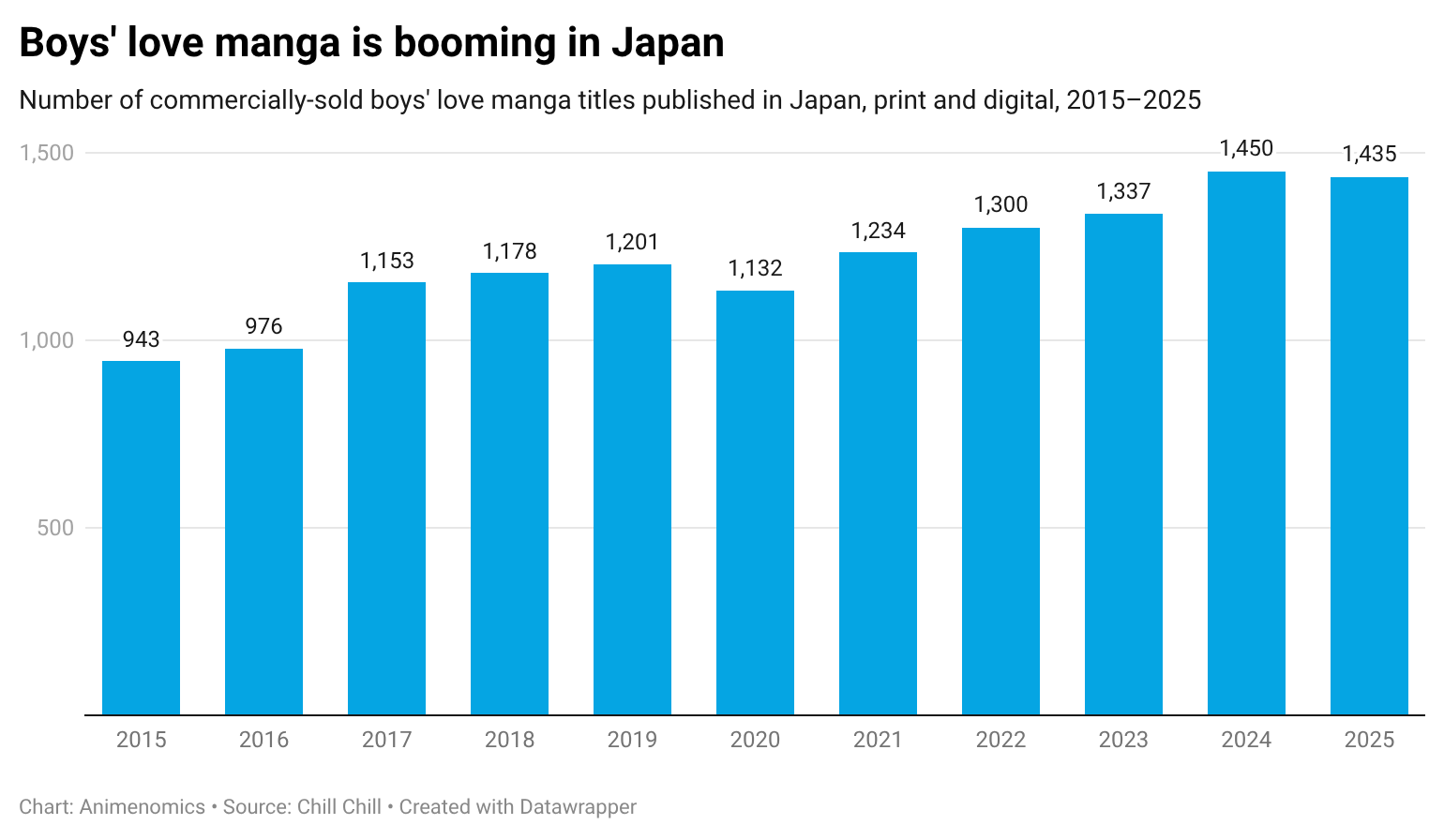
The number of homoerotic boys’ love manga titles published commercially in Japan edged down in 2025 but remains 52 percent higher than a decade ago, according to data compiled by boys’ love manga news website Chill Chill.
Why it matters: A growing pipeline of boys’ love manga means Japanese publishers have a growing catalog of titles available to license out to international markets, and its female-heavy readership will continue to grow outside Japan.
Animenomics is an independently run and reader-supported publication. If you enjoyed this newsletter, consider sharing it with others.
Hi. Do you know how an anime studio and a production company are defined in the report that mentions the growth rate of 8.4%?
I read their report every year, and I always have doubts about that. Is it just the money the studio receives for making the anime, or does it also include the licensing revenue as well?
Also, does it include the revenue received by, let's say, TV Tokyo, for licensing Naruto merch, etc.
Does it include revenue that Aniplex receives rather than studios like A-1 Pictures and CloverWorks? I am asking this because a lot of studios are at a loss while they are owned by a bigger company that collects the licensing revenue.
The 5.5 percent figure has an old origin story. Tezuka reportedly sold Astro Boy to NBC in 1963 at a price that barely covered production cost, and the industry has been negotiating from that discount ever since. Overseas fans grew up on cheap supply, and studios are still waiting for the money to travel back.