


This is a feature story from Animenomics, covering the business of anime and manga.
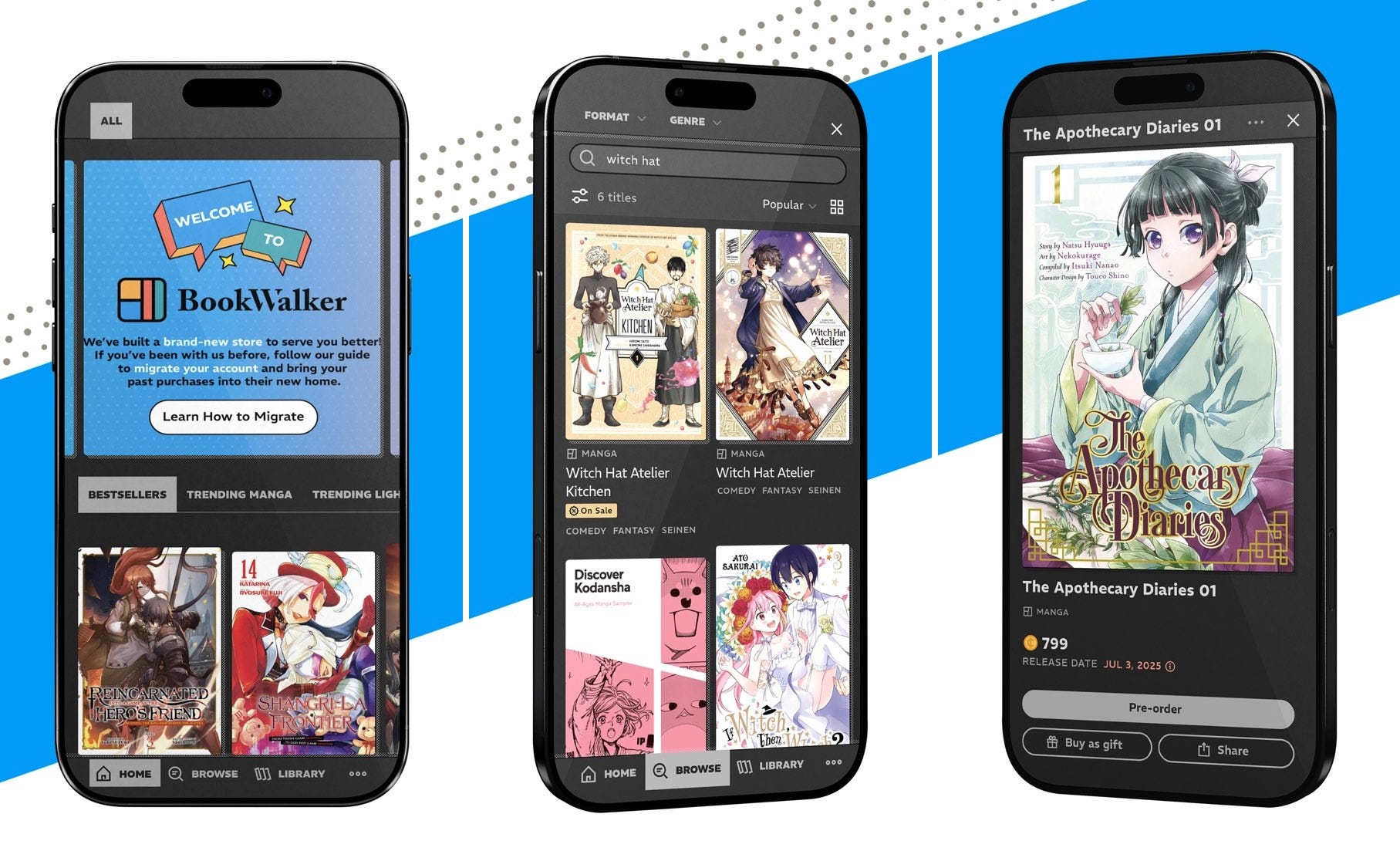
Kadokawa’s migration of BookWalker Global earlier this year to a new platform run by San Antonio, Tex.-based subsidiary M12 Media has opened a door for the English-language e-book store to grow beyond serving manga and light novels from Japan.
Why it matters: Since the closure of ComiXology by Amazon in 2023, no other digital comics platform has been able to reach the scale of its distribution catalog and fill the gap it left behind, but several players are already vying for the crown.
Webtoon Entertainment, the digital comics company controlled by South Korean internet giant Naver, is accelerating investment in North America, and New York-based GlobalComix earlier this year announced a US$13 million investment from Japanese and American venture capital firms.
What they’re saying: “We may very well start talking with the comics publishers and putting good old-fashioned comics on our site, assuming we can work out a deal,” M12 Media chief executive officer Samuel Pinansky told Animenomics in an interview earlier this year.
BookWalker Global already sells original English light novels from J-Novel Club, Pinansky’s digital publishing company that was acquired by Kadokawa in 2021, and is in talks to add manga-adjacent titles from other publishers.
The platform also sells comics and novels originally published in Korean from Ize Press, a joint venture of Yen Press, in which Kadokawa has a majority stake, and South Korea’s Redice webtoon studio.
The bigger picture: As reported by Animenomics, Kadokawa chief executive officer Takeshi Natsuno has said in interviews with Japanese media that the publishing giant could eventually source a large percentage of new works from outside Japan.
“I think what Natsuno-san is saying is let’s not worry too much about the original language of the content. If the work is […] attractive to our reader base, […] then, yeah, why don’t we carry those books,” Pinansky explained.
Rewind: BookWalker Global, like many e-book platforms, saw a large surge of users in early 2020 at the onset of the COVID-19 pandemic, with active users nearly doubling between February and April.
Following this newfound success, BookWalker’s corporate leadership undertook management reforms four years ago and began separating BookWalker Global’s identity from its Japanese domestic counterpart.
Those reforms didn’t come with a technology budget, however, and it wouldn’t be until around 2024 when it was decided that BookWalker Global needed to live on a separate platform from the Japanese service.
What we’re watching: E-book sales in the United States, which makes up the largest user market for BookWalker Global, slid 0.3 percent year-over-year in 2025, the first decline in three years, but Pinansky is optimistic that BookWalker Global can adapt to changing consumer behavior.
“The thing I worry about in the long term is that we are seeing less people reading,” he noted. “We need to reinspire the joy of reading in young people, and manga is one way to do that.”
Go deeper: Read the second part of our interview with M12 Media chief executive officer Samuel Pinansky about the relaunch of BookWalker Global’s e-book platform below.
BookWalker Global has been split off from BookWalker Japan and now sits in the same corporate entity as J-Novel Club. Can you give it a little bit of context into the background of how that happened and why Kadokawa decided to split up BookWalker?
Around ten years ago, BookWalker’s Japanese store, which at that point was already around four or five years old, expanded into selling English content. This was mostly because the Japanese publishers that worked with BookWalker had English content and English manga that they wanted to sell as well. This was little known, but there were actually some English manga sold on BookWalker Japan before BookWalker Global even started, which were mostly sold to Japanese people who wanted to learn English.
This sort of started the idea that they should launch BookWalker in English with big English publishers. At the time, Kadokawa was already in talks with Yen Press about purchasing them, and it was part of the overall global expansion for the company. That’s exactly what happened. They took the Japanese site, localized it, hired people who spoke English, made a global division, and BookWalker Global was born.
Fast forward many years later, there had been a lot of growth, COVID had happened, and there was more growth. Japanese BookWalker had grown into one of the biggest e-book stores for manga and light novels in Japan. BookWalker Global had also grown really large, and the manga market in the United States in English had also grown.
But despite the name, BookWalker Global was not really a global company. It was the Japanese company’s global division, and it was still operating very, very much like the Japanese store. Whether it was the way they were running campaigns, the organizational structure, the employees, or the way that they communicated with publishers, it was very Japanese.
The market for digital manga and light novels overseas is not the same as it is in Japan. The demographics are different, the marketing is different, and the incentives are different. Japanese people love loyalty programs where you stick with one store for five years and you finally get 5 percent off. Those sorts of promotions that work well in one area in the world just don’t work that well elsewhere. This was not something that Kadokawa was unaware of, but there were a lot of institutional problems to sort through. How do you run the global store in a different way than the domestic store when it’s really the same thing?
Around four years ago, some changes were made in the management of BookWalker Global and the way that marketing was being decided on, but that was not enough. Even if you change the way that the business decisions are made, the system was still the same Japanese system—the types of promotions, the front page, the way that the design works in the system, and the app development.
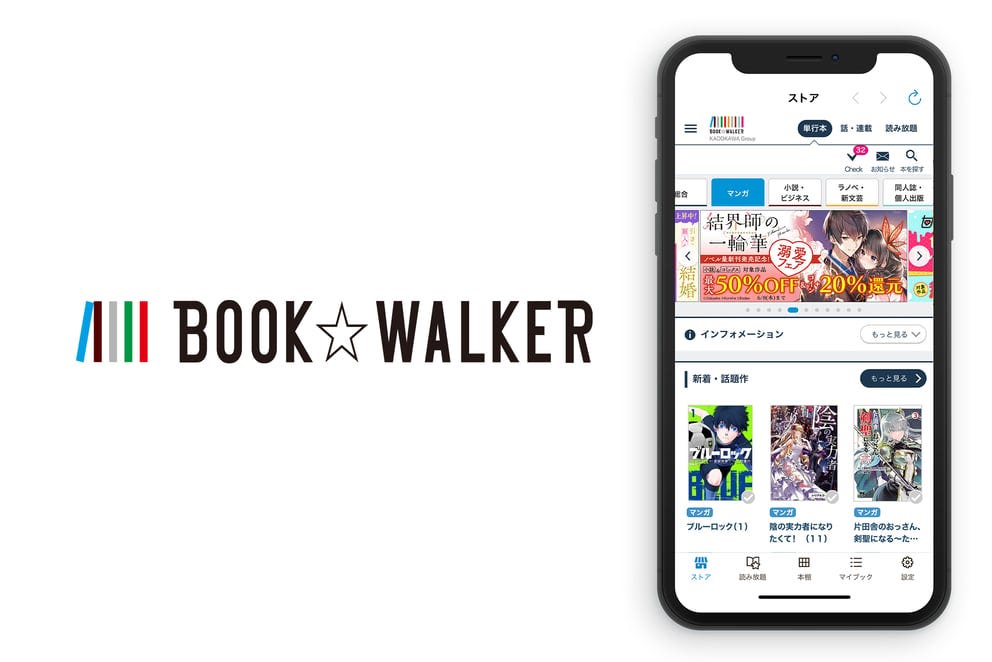
The app that you used for BookWalker Global was not a separate app. It was the same exact app as BookWalker Japan, just localized into English. To be frank, the design of the app works in Japanese, but it doesn’t really work in English. You need a separate app because of the reading direction, because of the way text works, and because of the aesthetics and the way text is displayed.
In order to execute different designs, you needed an entirely different tech budget, which didn’t exist, so the management reforms alone weren’t effective. Ultimately, Kadokawa knew that what they needed to do to really have BookWalker Global exist and thrive in the English market is to have it be its own business.
That was the original plan that started around two or two and a half years ago: to just create a new company overseas for BookWalker Global and transfer the global business to that new company. Because that new company was always going to be run by myself anyway as part of a proposal that I created maybe a year or a year and a half ago, it was actually decided that we could just use the J-Novel Club company. We didn’t need to create yet another company with yet another board of directors.
That is the origin of the transfer that happened April of last year, where J-Novel Club absorbed the BookWalker Global business. We also changed the name of the company to M12 Media in order to reflect that now it wasn’t just running the J-Novel Club business but also a separate BookWalker Global.
What does the name M12 Media mean?
We couldn’t just call the company J-Novel Club anymore because that would be rude to BookWalker Global. It also would not reflect things accurately, so we were trying to think of various names.
M can stand for manga. It can stand for media. It can stand for magic, mystery, and membrane. The M is designed to be ambiguous, but for the most part, it stands for media. We’re a media company that is producing, selling, and distributing media.
Twelve is a very important number in Asian culture, like the twelve signs of the zodiac. It sort of gives it this eastern play, but the real reason it’s called M12 is because I have a Ph.D. in string theory. In string theory, there’s a theory called the M-theory, which proposes an eleven-dimensional universe. In that theory, the M is also ambiguous.
I took that eleven-dimensional theory and went even one higher dimension to M12.
Did Kadokawa propose the vision where BookWalker Global would eventually become a separate platform when J-Novel Club joined the company, or did that come up later?
J-Novel Club was actually purchased by BookWalker, though not officially. Ultimately, we were purchased by Kadokawa’s U.S. holding company, which at the time was called Kadokawa Pictures America. It owns Yen Press, J-Novel Club, and M12 Media.
When I originally sold the majority share to Kadokawa, we were actually operated by the Japanese subsidiary BookWalker. The president of BookWalker was the primary person who was involved with the acquisition. All of Kadokawa was involved with the acquisition for due diligence, but I was reporting to BookWalker. I was actually on the board of BookWalker Japan up until the BookWalker entity was dissolved. We were very closely tied with BookWalker, but there was never a direct talk about BookWalker Global being managed by J-Novel Club at the time.
What ended up happening relatively soon after that was that the holding company was renamed to Kadokawa World Entertainment, more specifically the global business department of Kadokawa. About a year after our acquisition, management of J-Novel Club was transferred from BookWalker to the global business department, which was consolidating the management of all of the overseas subsidiaries, even though our board directors included many people with BookWalker and I was on the board of BookWalker. We were still very closely linked, but the reporting line went through the global business department.
The acquisition of J-Novel Club was much more about acquiring a successful digital-first light novel publisher. The combination with BookWalker Global was something that I would like to think a lot of the executives and myself always considered an option, and the opportunity to do this was there initially, but it became really clear that this was the right thing to do about two years ago after the issues with the management transfer, but the system transfer not being able to be fully independent. Then it just became a question of what’s the right vehicle to handle this business.
Support the journalism of Animenomics. By upgrading to a paid subscription, you gain access to M12 Media chief executive officer Samuel Pinansky’s outlook on the digital comics market in the United States, Europe, and elsewhere around the world.
