


This is your weekly Animenomics briefing, covering the business of anime and manga. Today is Wednesday, June 24, 2026.
In case you missed it: The Korea Creative Content Agency, the government agency responsible for providing funding to companies producing South Korean content, will kick off the third annual World Webtoon Festival next Wednesday in Los Angeles, one day before the start of Anime Expo.
Today is the last day to register for the kickoff business networking and creator networking events.
Fair Trade Commission sets anime contract guidelines

Japan’s Fair Trade Commission has published formal guidelines on anime production contracts in an effort to establish standard practices for players in the anime industry, from the production committees that commission new anime to the studios that make them and the streaming platforms that distribute them.
Why it matters: Japan wants to triple anime exports to ¥6 trillion (US$37 billion) by 2033, and it believes more governance is needed to transform anime into an IP-driven industry with sustainable management and human resources.
Anime companies already use contracts in many business dealings today, but the industry as a whole was historically built on numerous informal agreements, and the guidelines seek to change that practice.
Rewind: The publication is a culmination of an investigation into possible contract abuses in film and anime production that was launched in 2024 and whose findings were published at the end of last year.
What they’re saying: While 98 percent of primary contractor studios surveyed by the commission said that transaction terms with production committees are clearly stated, the guidelines encourage closer communication between the two sides.
To ensure the sustainability of studio operations, the commission emphasized the need for additional payments in production delays, reimbursement for work done in cancellations, and compensation when transferring copyright to committees.
The commission also urges increased transparency from streaming platforms in sharing viewer data during production fee negotiations to ensure fair compensation for anime creators.
The bigger picture: Despite the commission’s guidelines, the relationship between studios and production committees remains complicated.
“In recent years, the shortage of anime production lines has become chronic, and it isn’t uncommon for production committees to make requests that are almost like pleas, urging studios to secure production lines,” writes Gamebiz chief editor Hidehiko Kimura.
However, as previously reported by Animenomics, anime studio financials have diverged between larger studios and smaller ones, and not all studios have seen increased ability to negotiate higher fees from the shortage of production lines.
Anime and IP-based toys ties grow dominance in Japan
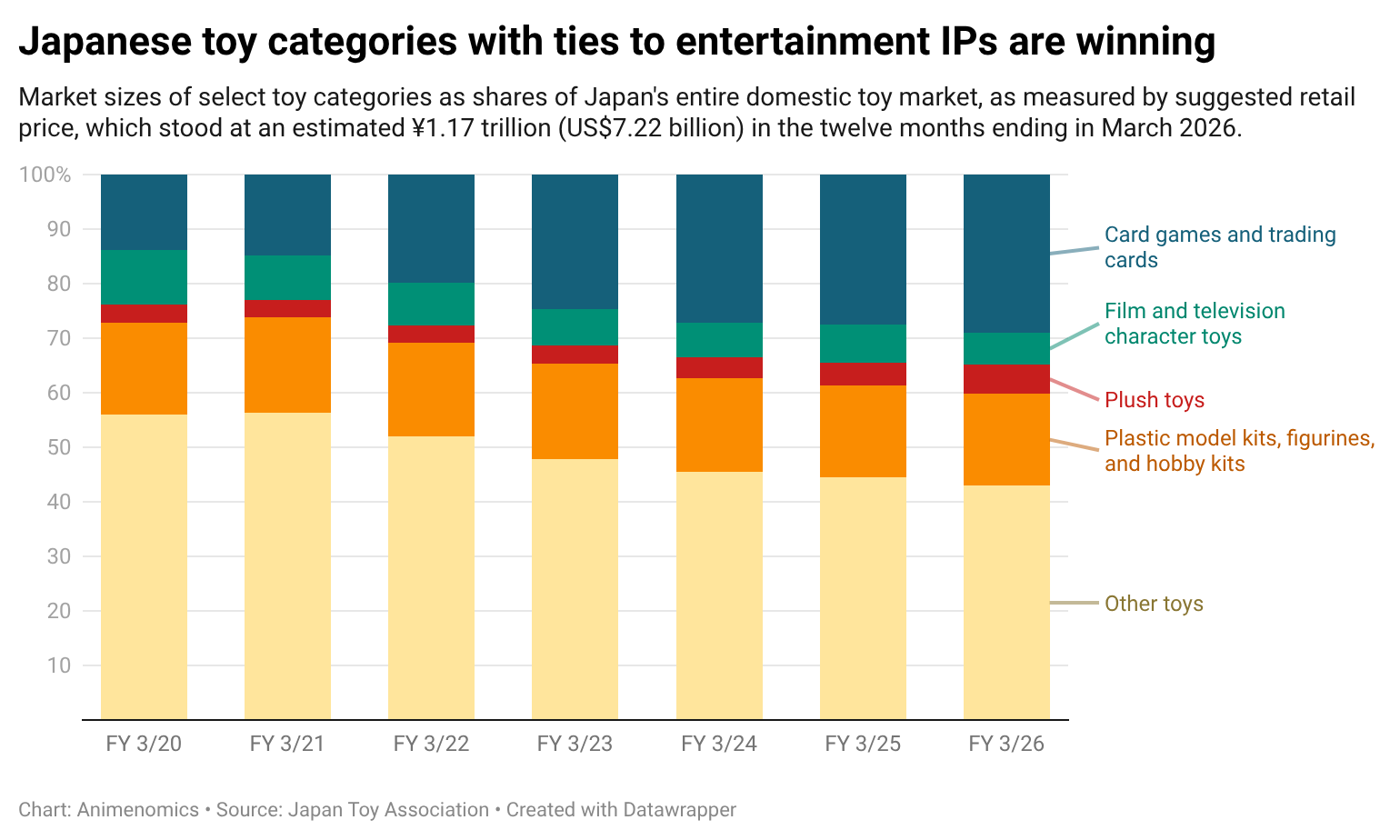
Japan’s domestic market for character merchandise and toys based on entertainment IPs, including anime, grew 9.3 percent to an estimated ¥665 billion (US$4.1 billion) in the twelve months ending in March 2026, according to Japan Toy Association data.
Why it matters: It’s the fifth year in a row that the growth in Japanese toy categories typically associated with entertainment and anime IPs has outpaced that of other toy categories.
Toy categories with IP ties now make up about 57 percent of Japan’s ¥1.17 trillion (US$7.22 billion) domestic toy market, a 13-point increase from seven years ago.
Zoom in: Card games and trading cards, such as the globally popular Pokémon cards, grew 12 percent, the eighth consecutive year of growth, and now make up 29 percent of the domestic toy market.
Japan’s trading cards are fetching high prices abroad, Nikkei Asia reports, driving increased demand as many are purchased in the country before finding their way overseas to be resold.
Aside from the Pokémon franchise, trading cards from Duel Masters and Yu-Gi-Oh! also drove growth in the category over the last year.
What we’re watching: Plushies reported the fastest growth rate of any Japanese toy category last year, growing 38 percent to ¥62.4 billion (US$386 million) in market size.
Monchhichi maker Sekiguchi has seen demand for the monkeylike stuffed animal surge for the first time since the 1980s after Pop Mart’s Labubu became popular.
Plushies from video game properties like Super Mario, Kirby, and Pokémon have also been popular.
Clippings: TV Asahi makes ‘Doraemon’ distribution push
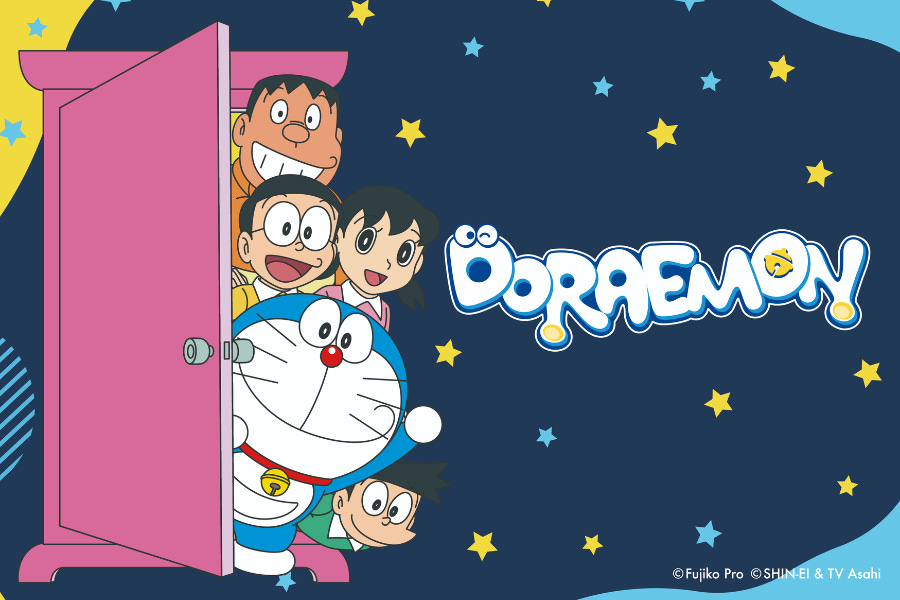
TV Asahi’s Doraemon anime could see a new distribution push in the United States, Canada, Australia, New Zealand, and multiple European markets under a distribution deal with London-based Cake Entertainment. (Licensing Magazine)
TV Asahi is also partnering with India’s PVR INOX Pictures to bring Doraemon the Movie: New Nobita and the Castle of the Undersea Devil into the country, one year after Crayon Shin-chan opened in Indian cinemas, and with Eurozoom in France.
Crunchyroll will enter South Korea later this year, where it’s expected to run head-to-head with local anime streaming leader Laftel, which is operated by pay television broadcaster Aniplus and investment firm Keistone Partners. (The Korea Herald)
Laftel is South Korea’s only profitable streaming video platform and distributes 90 percent of new anime titles released in Japan, Maeil Business Newspaper reported in 2024.
Zoom out: Crunchyroll’s debut in South Korea comes after earlier Asian launches this year in Thailand and in Taiwan.
Japanese government plans for a unified domestic platform for subscription-based digital manga distribution are running into early resistance from publishers who prefer to maintain their own platforms. (The Mainichi)
Japan’s vending machine operators and manufacturers are tapping into customers’ ‘oshikatsu’ spending with new machines that dispense acrylic cards featuring anime characters and beverage cans printed with names of favorite pop stars. (Nikkei Asia)
Isao Takahata anime short The Adventure of Panda and Friends is finding renewed popularity in Japan months after the last giant pandas left the country amid tensions between Tokyo and Beijing. (The Yomiuri Shimbun)
China’s animation boom faces AI and cost disruptions
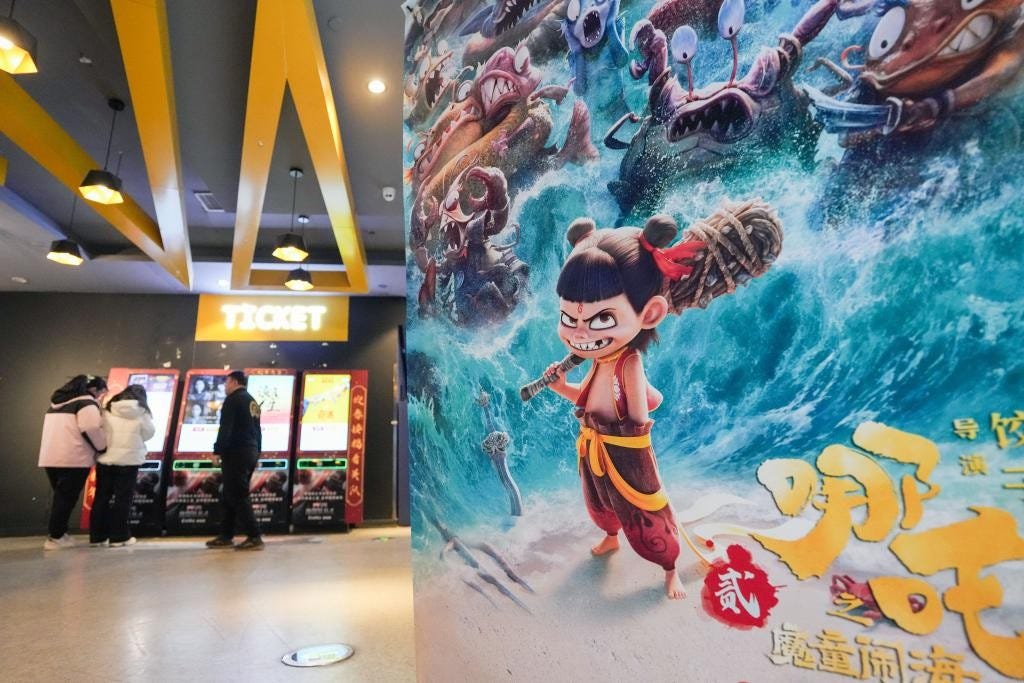
After a blockbuster year in 2025, China’s animation industry is facing new headwinds from labor constraints and disruptions from artificial intelligence technology, putting pressure on studios, the Caixin Weekly magazine reports.
Why it matters: Expectations from Chinese audiences for visual and narrative quality have grown after Ne Zha 2 earned a record CN¥15.4 billion (US$2.3 billion) last year, capturing a 30 percent share of the country’s total box office earnings.
What’s happening: A shortage of capable animation directors and screenwriters has created a bottleneck in China’s animation industry, says Wang Changtian, chairman of Beijing Enlight Media, the studio behind Ne Zha 2.
China’s 2D animators are facing high workloads and mediocre pay. Key animators aren’t typically paid a salary, relying instead on piecework compensation while enduring lengthy development cycles.
3D animation projects with more established industrial processes have grown in number, but most projects involve up to 1,000 or 2,000 people, placing immense pressure on the production system.
The other side: While AI-generated animation has fallen short of theatrical standards and has yet to make their way into high-end production workflows, now low- and mid-budget productions are being threatened by the growth of AI motion comics.
“Since late 2025, platforms have been advising content suppliers to incorporate AI to cut costs,” a streaming platform insider familiar with motion comics told Caixin.
In the past, these platforms regularly commissioned animation series from more traditional Chinese animation studios, which typically employ between 50 and 100 people and whose animators have been resistant toward AI.
Animenomics is an independently run and reader-supported publication. If you enjoyed this newsletter, consider sharing it with others.
I would not be surprised to see Crunchyroll launch in Japan over the next 12-16 months. There’s no way they’d go for Korea and Taiwan, and not have Japan in their sights.