


This is a feature story from Animenomics, covering the business of anime and manga.
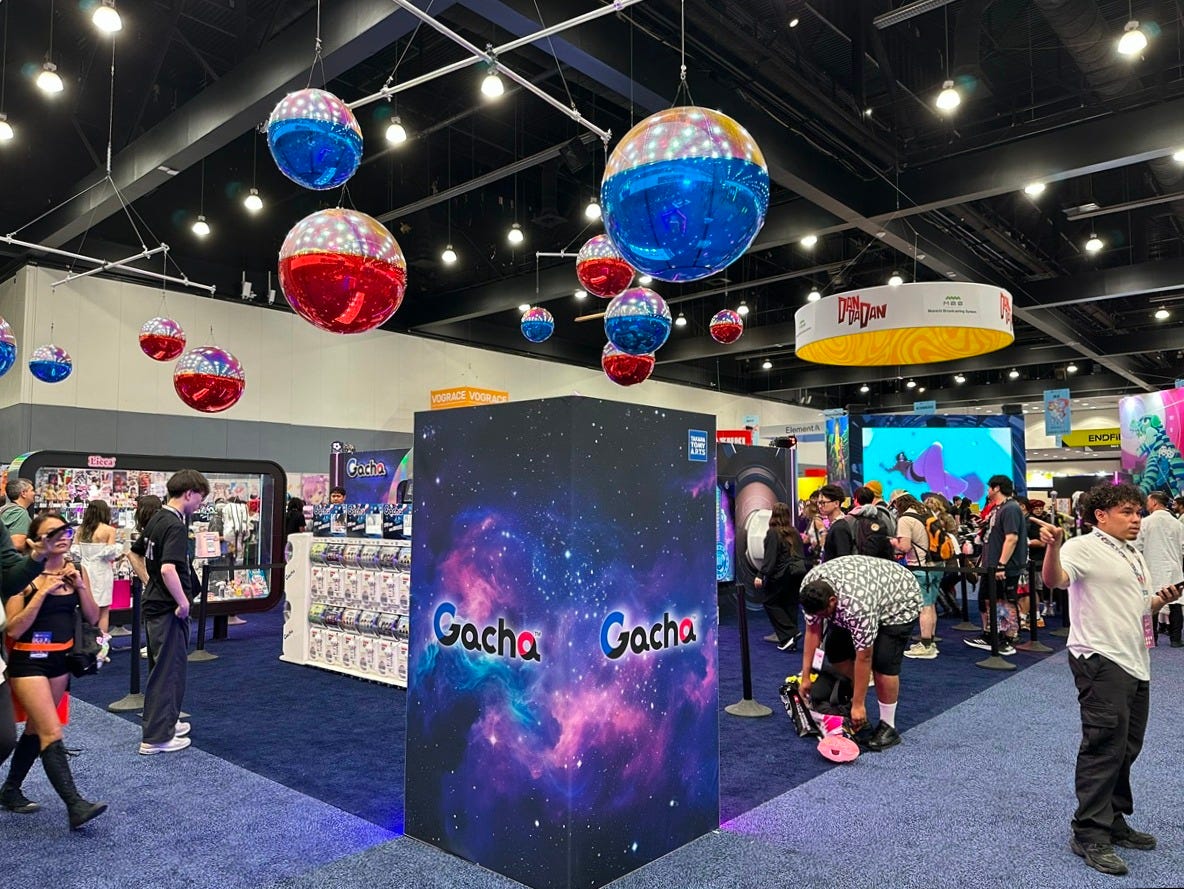
Toymaker TakaraTomy Arts is undertaking an ambitious plan to grow the footprint of its Gacha capsule toy vending machines in North America, through partnerships with amusement giant Genda and with trading conglomerate Mitsubishi and Sega Fave.
Why it matters: By focusing on selling capsule toys with ties to established Japanese anime and mascot characters, TakaraTomy Arts is filling a gap in the market for anime character merchandise in the United States.
In Japan, where capsule toys celebrated 60 years on the market last year, their popularity of capsule toys has also surged since the COVID-19 pandemic, both among locals and with visiting tourists.
What they’re saying: “The U.S. capsule toy consumer is someone who already has an interest in Japanese IPs, so there is a strong tendency for them to buy Japanese IP products,” chief executive officer Toshihisa Kondo told Animenomics in an interview at Anime Expo earlier this year.
Zoom in: TakaraTomy Arts has been piloting a capsule toy specialty retail experience in Santa Monica, Calif., with Mitsubishi and Sega Fave, creating a destination for fans looking to buy anime merchandise.
“The goal of this store is to bring together the best products among well-established Japanese IPs from TakaraTomy and the other two partners and create an authentically Japanese multi-brand retail experience,” managing director Toshio Hasegawa explained.
Separately, the company has also partnered with amusement giant Genda to place Gacha machines across its vast crane game operation throughout North America.
What we’re watching: TakaraTomy Arts is also redeveloping some capsule toy lines into figurines to sell in blind boxes, seeking new ways for customers to experience the excitement and anticipation of winning a toy.
Go deeper: Read our interview with executives from TakaraTomy Arts on approaches to product development for capsule toys and blind boxes.
TakaraTomy Arts has been expanding the presence of Gacha machines in North America. What have you observed in the demand for capsule toys among North American consumers? Are there differences from Japanese consumer behavior?
Toshihisa Kondo, president and chief executive officer: When it comes to the differences in consumer preferences between Japan and the United States, generally, the U.S. capsule toy consumer is someone who already has an interest in Japanese IPs, so there is a strong tendency for them to buy Japanese IP products. However, in Japan, capsule toys have been around for 60 years, so whether they are IP products or not is not so important for the consumer there. You could say that the U.S. is a narrow and deep market, whereas, in Japan, it’s broad and shallow with a much wider range of options available.
As I mentioned, there are a lot of non-IP products in Japan, but one of the things that we’ve discovered recently after launching Gacha in the U.S. is that there is also interest in our non-IP products here. We’re talking about products that don’t use characters or mascots, for example, cute animals or miniature replicas of popular food items.
How do you choose the types of IP characters and non-IP products to bring to North America?
Kondo: When we’re considering IP products, we’re choosing from things that have demonstrated market popularity in Japan, and we choose from among those what is popular in the U.S. after conducting various surveys of the market.
For products that don’t have a character associated with them, we’re essentially taking a risk on them.
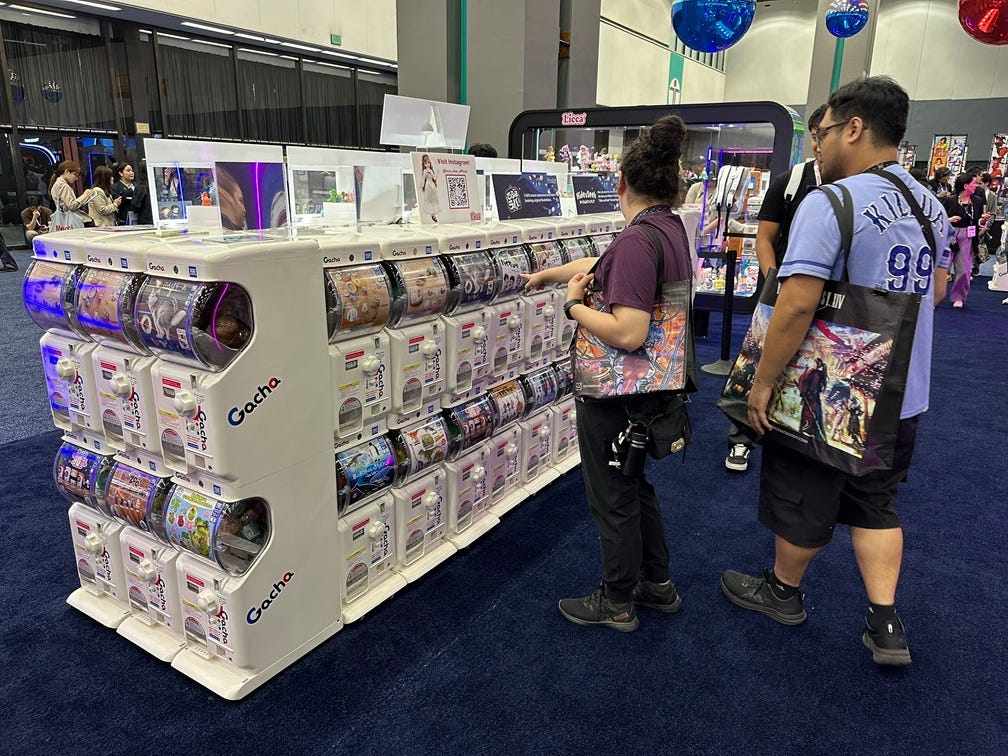
You’re taking two approaches to expand Gacha in North America. One is a partnership with Genda and its Kiddleton subsidiary. The other is a joint venture with Sega Fave and Mitsubishi. How do these two approaches differ from one another?
Toshio Hasegawa, managing director: Yes, you understand well our two approaches.
One is a store in Santa Monica, a collaboration between TakaraTomy Arts, Mitsubishi Corporation, and Sega Fave, focusing on capsule toys, crane games, and merchandise such as figurines. We gather various Japanese IP products in a combined storefront called Gatcha & Catch. The goal of this store is to bring together the best products among well-established Japanese IPs from TakaraTomy and the other two partners and create an authentically Japanese multi-brand retail experience. Based on the success in Santa Monica, we are currently planning to expand on this concept.
In the second model, we are working with Kiddleton, which already has approximately 13,000 crane game locations across the United States. Working with them, we would like to introduce our Gacha machines in places where the crane games already exist, such as Walmart, H-Mart, and various specialty stores. By installing them in supermarkets, movie theaters, and all kinds of other businesses, the goal is to create a synergistic effect between the crane game and Gacha machines.
The Japan Toy Association reported that plush toys had the fastest growth rate of any toy category in Japan last year, growing 38 percent. It’s also a major product category at TakaraTomy Arts. What approach are you taking in product development in this area?
Kondo: Plush toys are part of TakaraTomy Arts’s core business, and thanks to strong growth in the Japanese plush toy market, growth in our plush toy sales is also vibrant.
In Japan, we traditionally had understood plush toys as something that was limited to the kids’ market, but in recent years, their appeal has expanded to include “kidults”. We see a broader consumption of plush toys in the Japanese market. This goes so far as male consumers now collecting plush toys. One recent trend we see in Japan is attaching a ball chain to small plush toys to turn them into keychains, which people then attach in large numbers to their bags. This is something that’s been developing, and we’ve been following that growth.
We’ve really been trying to increase the range of possibility for consumers. We don’t rely just on the trend of these keychain-style plush toys. We’ve devised a new sales approach called “nuidori”, a Japanese term for taking photos with plush toys. We also offer a wide range of products, from standard plush toys to be displayed at home or hugged to enormous plush toys that are the same size as the actual characters. We provide our customers with a diverse selection of products.
Support the journalism of Animenomics. Upgrade to a paid subscription to access insights on the capsule toy development strategy at TakaraTomy Arts, including the company’s outlook on the blind box market and future plans to bring Japanese amusement machines to North America.
