


This is your weekly Animenomics briefing, covering the business of anime and manga. Today is Wednesday, January 28, 2026.
In case you missed it: Dragon Ball Super’s anime will be rereleased with new footage and updated visuals and sound later this year, and a sequel series is also being made as part of the Dragon Ball anime franchise’s 40th anniversary.
Print manga sales tumble, digital manga slows down
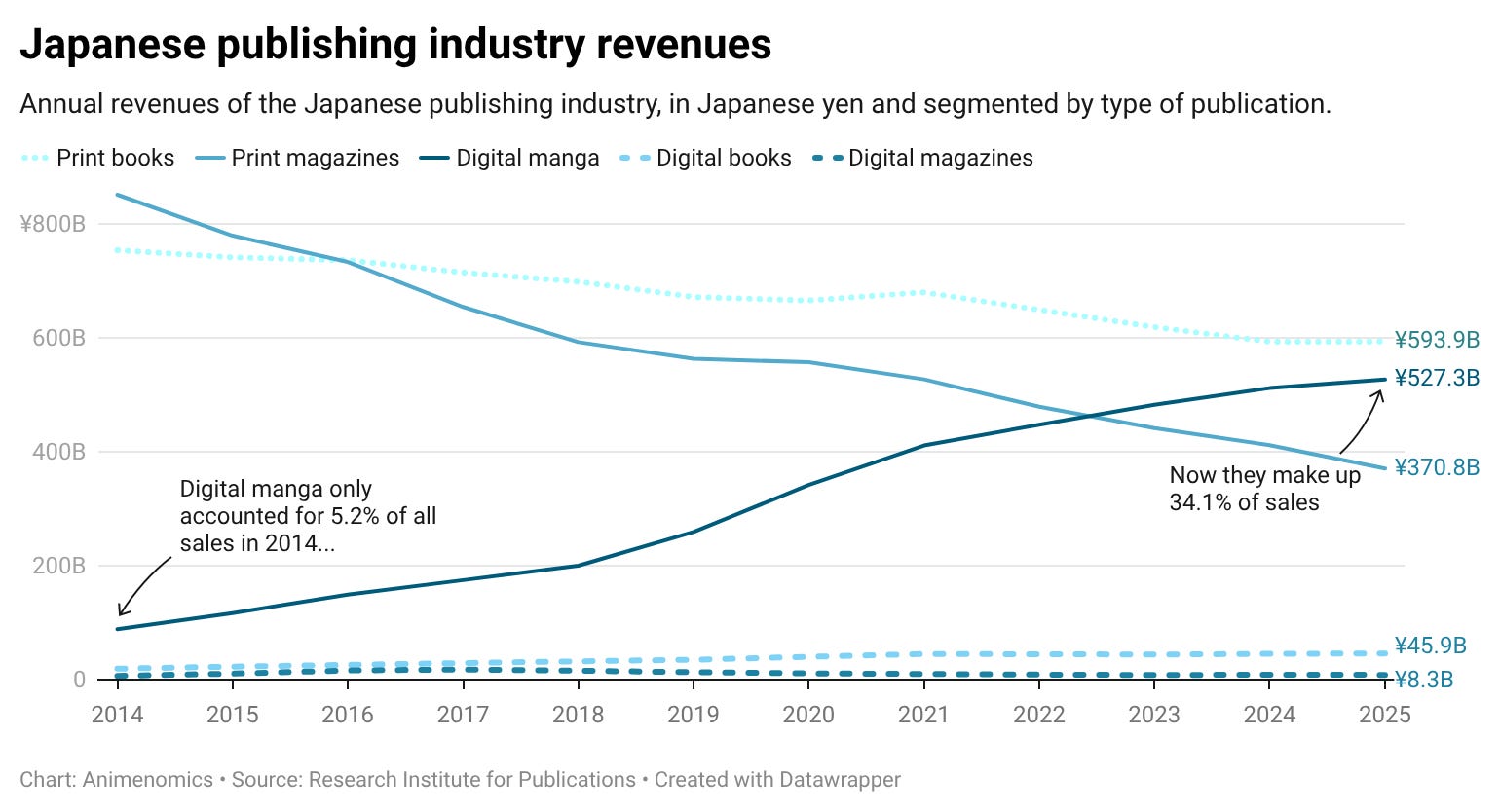
Sales of print manga volumes in Japan fell 15 percent last year, the biggest drop since 2022, when the pandemic-era buying surge ended, newly released annual publishing industry data compiled by the Research Institute for Publications show.
Driving the story: After several hit manga titles—My Hero Academia, Jujutsu Kaisen, and Oshi no Ko, for example—ended publication in 2024, no new hit titles emerged in their place in 2025, suppressing overall print sales.
Zoom in: Japan’s print publishing market fell below ¥1 trillion (US$6.5 billion) for the first time in 50 years.
This figure is far below the print publishing market’s peak of ¥2.6 trillion in annual sales in 1996.
Between the lines: Digital manga sales, which make up three-quarters of the manga market, continued its growth trajectory last year, but only at a rate of 2.9 percent, the category’s slowest growth rate on record.
As previously reported by Animenomics, year-over-year growth of digital manga in Japan in the first half of 2025 was recorded at 4.6 percent.
In the second half of the year, however, annual growth was just 1.5 percent, a warning sign that digital manga’s growth could come to an end sooner rather than later.
The bigger picture: Japan’s broader publishing market, meanwhile, fell 1.6 percent to ¥1.55 trillion (US$10.1 billion), the fourth consecutive year of decline.
Japan Foundation promotes anime films in African tour

Japan’s agency for cultural promotion abroad, the Japan Foundation, is starting the new year with an acceleration of its two-year campaign to develop a market for anime films in African countries.
Why is matters: Africa remains largely untapped for the anime industry, with the continent accounting for only 4.7 percent of all contracts signed between Japan’s anime companies and international parties in 2024, according to the latest industry survey by the Association of Japanese Animations.
What’s happening: The foundation’s Japanese Film Festival Africa Tour will travel to 14 countries throughout 2026 after stops in Ethiopia, Nigeria, and Rwanda last year.
This weekend’s stop in Cairo will feature Studio 4°C president and producer Eiko Tanaka, who is scheduled to give a special lecture to local film and anime officials, Branc reports.
Next month, the festival travels to Nairobi, where it will focus on showcasing anime films like Akira and Sand Land, and it’s expected to fuel collaborations between local animators and Japanese creators, The Star newspaper reports.
A number of anime titles like Attack on Titan and Your Name are also being made available online in all 54 countries of the continent.
Reality check: Streaming platforms and new fan conventions are fueling growth in anime viewership, but the Japan Foundation recognizes that awareness of Japanese content among the public and the local media industry is still low.
“While Africa contributes to viewership numbers, engagement metrics, and cultural relevance, it does not meaningfully participate in IP ownership, studio production, licensing negotiations, merchandising supply chains, adaptation rights, and financing decisions,” Lagos-based influencer marketing agency TIMA argues in a recent newsletter.
Clippings: Manga publishers recruit more foreign artists

Japanese manga and webtoon companies are increasingly recruiting foreigners to become manga artist, putting them in training programs and housing them in dorms to facilitate their introduction to the manga industry. (Nikkei the Style)
South Korea’s Kakao Entertainment has forced the closure of manga and webtoon pirate website Batoto and its user communities, which saw millions of monthly visitors. (TorrentFreak)
An unorthodox anti-piracy unit within Kakao Entertainment that regularly recruits informants in order to bring legal action to pirate sites claimed responsibility for Batoto’s closure.
LINE Yahoo! Japan’s domestic flea market app is moving to ban high-priced resales of new Gundam robot plastic models after high demand for certain products led to shortages at toy and hobby retailers. (Otaku Lab)
Eleven percent of manga artists and 14.5 percent of illustrators surveyed by the Freelance League of Japan say that their incomes have decreased by at least 10 percent as a result of artificial intelligence technologies. (ITmedia AI+)
About half of manga readers in Japan have no strong positive or negative opinion on the use of artificial intelligence in manga production, according to a new survey of 1,000 people, but two-thirds of respondents are resistant to reading manga that are mostly produced by AI. (AdverTimes)
Mizuki Shigeru Museum and its surrounding attraction in western Japan’s Tottori Prefecture has seen international visitors double in the last three years, with visitors from Hong Kong, Taiwan, and elsewhere flocking to see characters from the manga author’s works. (Nikkei Asia)
Wine manga screen adaptation faces French legal limits

The arrival of a second season of the live action Drops of God television series, loosely based on Tadashi Agi and Shu Okimoto’s The Drops of God manga, revives a debate in France over legal barriers in the country’s illustrious wine industry.
Why it matters: The multinational production, which includes Hollywood’s Legendary Television, national broadcaster France Télévisions, and Hulu Japan, was named Best Drama Series in the 52nd International Emmy Awards.
Catch up quick: Since 1991, French law has prohibited the promotion of alcohol on television or in cinemas, which means a television series about wine like Drops of God can’t promote the wines it features.
As was done in the first season, the French broadcast of the second season will blur wine bottles and their labels, according to La Revue du vin de France, one of the country’s most highly regarded wine publications.
“It’s absurd in the country of wine, which represents a vital part of our agricultural trade balance. We should be proud of our heritage,” sommelier and restaurateur Sébastien Pradal, who selected the show’s featured wines, told the magazine.
In Japan, however, as previously reported by Animenomics, real-life vintages that were featured in the original manga became bestsellers overnight.
By the numbers: While Drops of God received wide critical acclaim when it debuted on Apple TV in 2023, the French television broadcast the following year didn’t see the same success.
An estimated 2.87 million people—a 14.2 percent market share—watched the first episode, but viewership fell 38 percent by the last episode.
Animenomics is an independently run and reader-supported publication. If you enjoyed this newsletter, consider sharing it with others.
The foreign artist recruitment story is huge and underreported. I work with artists across borders and the cultural translation challenge is real — it’s not just about drawing skill, it’s about understanding how Japanese storytelling rhythm works on the page. Curious to see if publishers treat this as a talent pipeline or just a cost play.