


This is a feature story from Animenomics, covering the business of anime and manga.
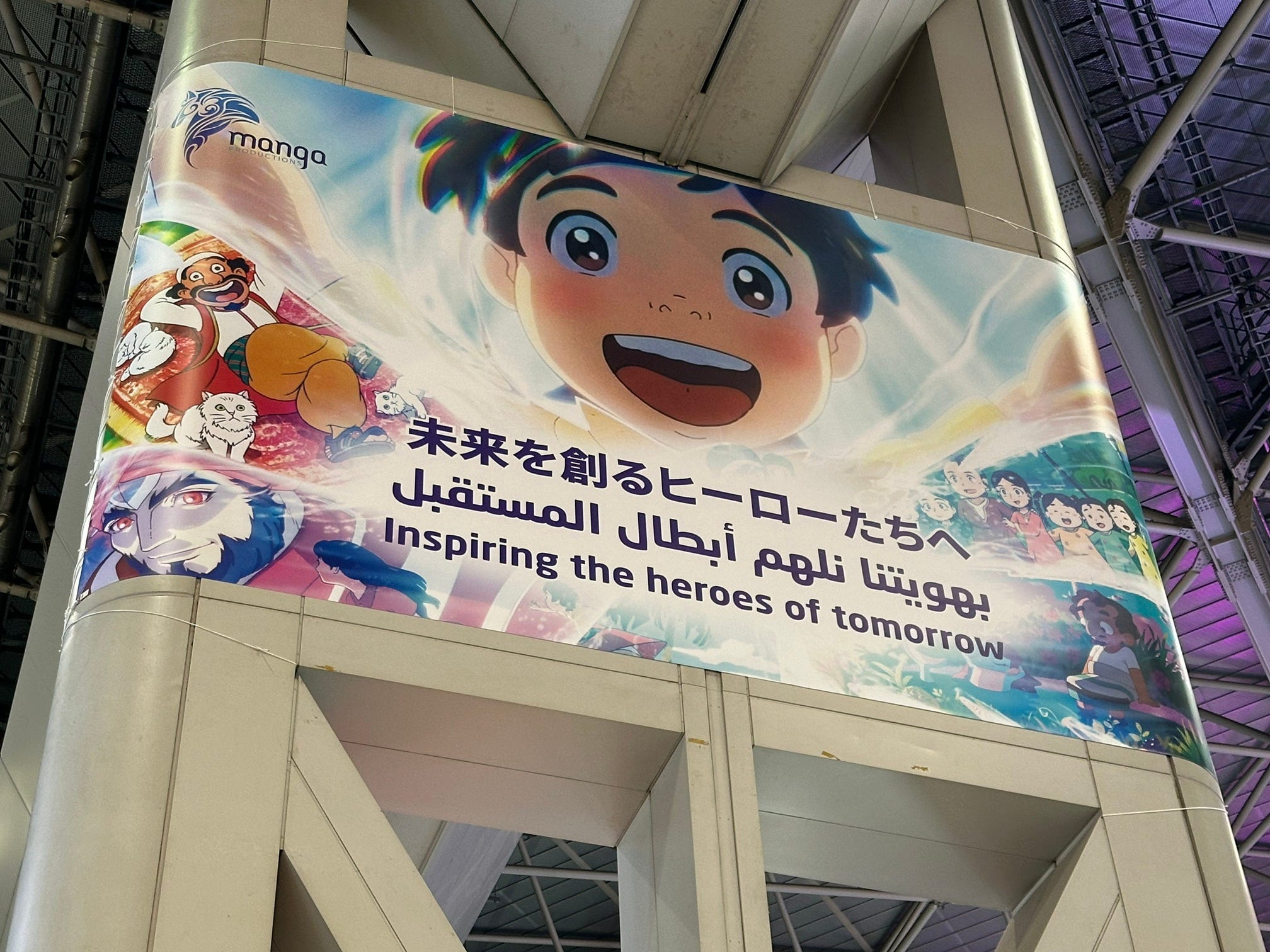
Saudi anime production studio Manga Productions is pivoting toward production of its own intellectual properties after years of working with Japanese anime companies to co-create and import anime into Saudi Arabia.
Why it matters: Manga Productions is capitalizing on a rapidly growing entertainment market at home and in the Middle East as Saudi Arabia eases cinema restrictions and shifts its economy from oil toward culture and entertainment.
“For many decades, Saudi Arabia had been a country that consumed content, but now we are producing our original content,” chief executive officer Essam Bukhary told Animenomics in an interview at AnimeJapan earlier this year.
Zoom in: At the Annecy International Animation Film Festival and Market earlier this summer, Manga Productions announced Henna, its first in-house anime project.
Creating its own IPs has also allowed the company to build rapport with Japanese anime rightsholders when acquiring titles for distribution in the Middle East.
“Being IP producers means that we understand how difficult and how challenging it is to produce IP, and we understand how important it is to protect our IP,” said Bukhary.
What we’re watching: Manga Productions intends to introduce artificial intelligence technology in its production processes whenever possible, but Bukhary acknowledged some employees are resistant toward the introduction of AI.
Bukhary likens Japan’s entertainment content industry today to its electronics industry of the 1990s, faced with the pressure to transform as new competitors and new technologies enter the market.
Go deeper: Read our interview with Manga Productions chief executive officer Essam Bukhary about the company’s various initiatives below.
Please introduce Manga Productions and what the company is about.
Manga Productions is a Saudi company. We produce anime, we develop games, and we also produce manga. We do the IP management for anime distribution, game publishing, IP licensing, but our greatest mission is to inspire the heroes of tomorrow. Our real business is to use the power and impact of content to shape a better future for those young generations by providing them with good content.
Can you speak about the demographics of those young people in Saudi Arabia and the Middle East? What kind of shows do they enjoy?
Seventy percent of the population is under the age of 35, so we are a very young country. I think this is similar to other countries in the region.
I grew up watching Japanese anime—Captain Tsubasa, Grendizer, Rose of Versailles—so I was inspired by those anime. When I decided to come to study in Japan, I watched the anime that I used to watch in my childhood to learn Japanese.
Now, in Saudi Arabia, even in the Arab world, a lot of the young generation are very keen toward Japanese anime. Even my daughter, who is 15 years old, started watching Haikyu!! After watching, she decided to play volleyball. It changed her character. Her academic performance became better, and she became a public scholarship student just last month.
I can say with full confidence that Haikyu!! changed the life of my daughter. I think it’s happening with a lot of kids in the young generation in Saudi Arabia.
Outside of anime, what kind of content have there been traditionally for children in Saudi Arabia, and what makes anime so different from local content?
If you look at food, we have healthy food and junk food. This is identical to content. There are junk content and good content.
In general, Japanese content are very deep. They have deep, meaningful messages, especially about the growth of characters. In a lot of comics, you find superheroes who eat something, take some medicine, or go to another planet and become superheroes. In most Japanese anime, they have very weak characters. Step by step, they become strong and try to achieve their goals. This is what makes Japanese anime more relatable to young audiences. You find the ethics of friendship, of achieving your dreams, of taking care of your family, your loved ones. All those things make Japanese anime very attractive to many audiences.
For many decades, Saudi Arabia had been a country that consumed content, but now we are producing our original content. We are very glad that, for example, The Journey was the first ever movie from the Arab world to be premiered in the Chinese Theatre in Hollywood. It was the first IP from the Arab world on the Chinese platform Bilibili. We had Jackie Chan as a voice actor. We had premieres in Indonesia, Malaysia, Hong Kong, Saudi Arabia, and Japan as well. This shows how we can transform from being a content consumer into a content producer and content exporter.
So what’s next? We have been producing content, distributing our original content. Now, we are dealing with Japanese content, and we are exporting them to the world. This is what happened with Grendizer U, for example. We are distributing that globally excluding Japan, Captain Tsubasa in MENA, and Great Pretender in MENA as well. We are also publishing different games. Recently, we started publishing Dynasty Warriors in MENA in Arabic, Nioh 3, and Sonic Racing: CrossWorlds. We are very glad that last year we won two awards for best localization.
The next stage is we are taking those IPs into the entertainment industry. You may be familiar with the statue of Grendizer in Riyadh, 33 meters tall. It is in the Guinness Book of World Records. We are dealing with IPs in 360 degrees, so the future is not dealing with IP and content only on screens online. You have to go offline, and going offline is the key to success.
According to a number of data, between 2024 to 2030, the growth rate of the anime and entertainment business in Japan will be 4 percent. Globally, it is 7 percent. In Saudi Arabia and MENA, 14 percent. It’s a great potential here in the region.
What are the challenges that you’ve had in working with Japanese companies? Are they open to working with foreign partners in distribution, especially with Saudi partners? If they don’t have experience in working with Middle Eastern companies, are there certain challenges in that area?
Within our company, I think we are very glad to have Japanese team members and made-in-Japan Saudis, those young talent who studied and graduated from Japanese universities. They can not only speak Japanese but understand the mentality and the business culture of our friends in Japan. Having that differentiates you from many other companies, and especially when you have your branch in Japan, especially when you participate in AnimeJapan for four years in the business days and public days, and people see you and interact with you, that makes you more familiar to our friends in Japan.
There is a Japanese proverb “tooi shinseki yori chikaku no tanin”, which means a stranger who is near to you is better than a relative who is living far from you, so I tell our friends in Japan that we are not faraway strangers. We are not nearby strangers. We are nearly friends. That’s all facilitating our work with Japanese companies.
I think one point that supported Manga Productions in our business with Japan is that we produce our original IPs. Being IP producers means that we understand how difficult and how challenging it is to produce IP, and we understand how important it is to protect our IP. Having that experience and having that knowledge, it makes it easier for us to negotiate with other Japanese IP holders when dealing and managing their IPs in the region.
Support the journalism of Animenomics. By upgrading to a paid subscription, you gain access to Manga Productions chief executive officer Essam Bukhary’s views on anime production committees, the role of artificial intelligence in anime, and the industry’s future global workforce.
