


This is your weekly Animenomics briefing, covering the business of anime and manga. Today is Wednesday, February 25, 2026.
In case you missed it: Manga sales in the United States returned to growth in 2025 after two straight years of decline, with sales revenue up 4.6 percent and unit sales up 8.1 percent, trade publication ICv2 reports, citing Circana BookScan data.
Domestic manga market shrinks for first time since 2017

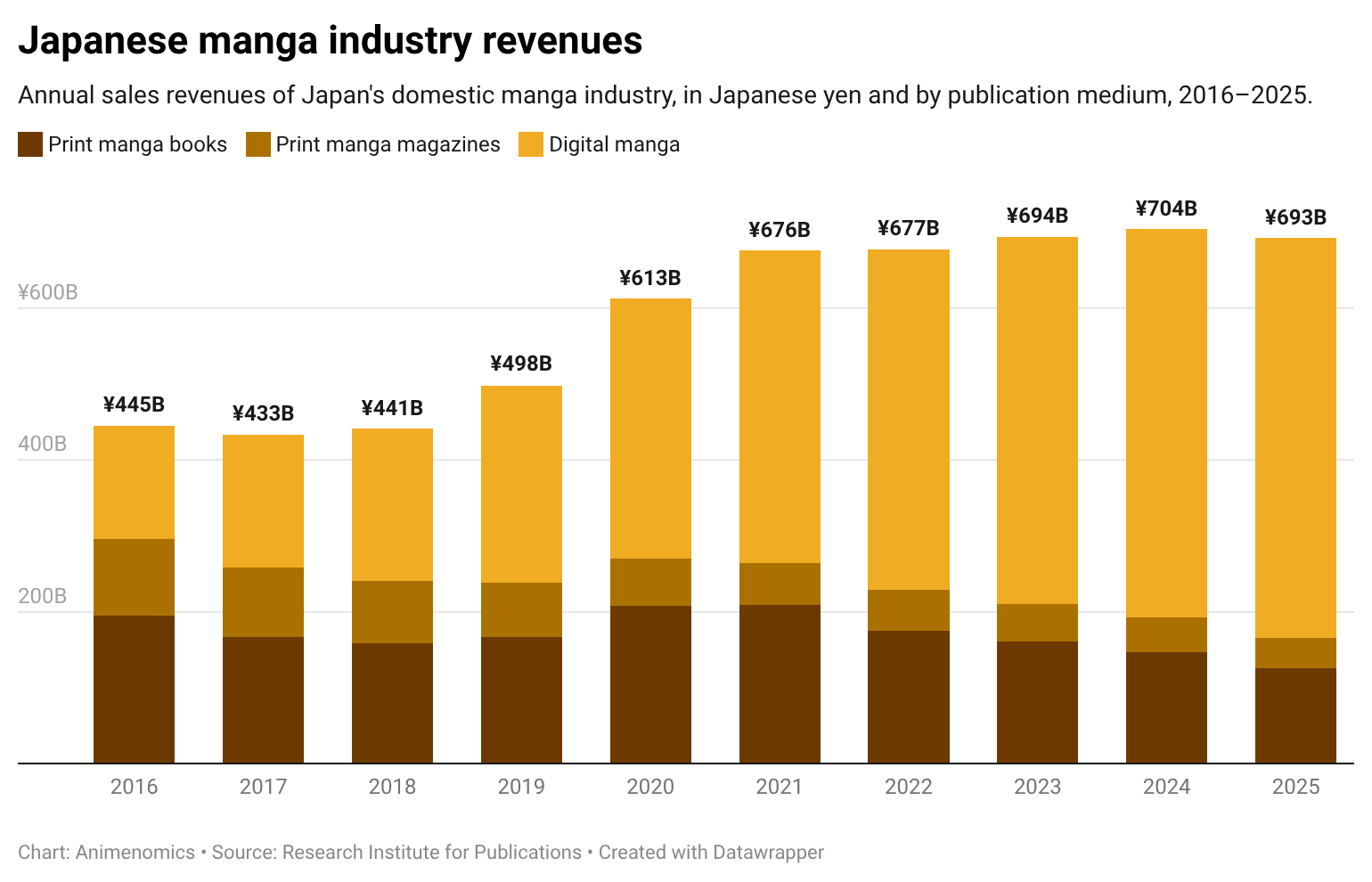
Japan’s domestic manga sales fell in 2025 for the first time in eight years, according to publishing industry data compiled by the Research Institute for Publications, a unit of the All Japan Magazine and Book Publishers and Editors Association.
Why it matters: A quickening slowdown in digital manga sales in the second half of the year meant that the pace of digital growth can no longer reliably compensate for the tumbling print manga market.
By the numbers: The domestic manga market shrank by 1.7 percent to an estimated ¥693 billion (US$4.45 billion).
Sales of print manga volumes fell by 14.4 percent, while manga magazines fell by 12.7 percent.
As a result of digital manga’s 2.9 percent growth, its market share expanded to 76.1 percent of total sales, exceeding three-quarters of the manga market for the first time.
With Japan’s broader publishing market also shrinking, print and digital manga’s combined share remained at 44.8 percent of total publishing sales.
Zoom in: Manga titles with popular anime adaptations like Medalist and The Fragrant Flower Blooms with Dignity, both from Kodansha, sold well in Japan last year.
However, no title came close to reaching the sales levels of My Hero Academia, Jujutsu Kaisen, and Oshi no Ko, all of which ended publication in 2024.
Sales of manga magazines took a hit as convenience stores continued to reduce shelf space for books and magazines.
Between the lines: Publishers aren’t necessarily releasing fewer manga despite the falling sales revenue.
New manga volume releases actually jumped 6.5 percent year-over-year in 2025 to just over 16,000 new titles, the largest annual increase since 2008.
Go deeper: I write about how publishers are preparing for a future of declining manga sales on ICv2.
Netflix exclusive ‘Cosmic Princess Kaguya’ hits cinemas

Anime film Cosmic Princess Kaguya! landed in fifth place in Japan’s box office rankings over the four-day holiday weekend, shocking Japanese film industry observers after it earned ¥291 million (US$1.87 million) despite being released on Netflix a month ago.
Why it matters: The success of Cosmic Princess Kaguya! in the box office “overturns the conventional wisdom that streaming is the enemy of movie theaters”, writes entertainment industry expert Motohiko Tokuriki.
How it happened: Cosmic Princess Kaguya! opened on Friday for a one-week limited engagement in just 19 theaters throughout Japan.
Rather than rely on Netflix’s marketing channels, production planning firm Twin Engine opened dedicated social media accounts to market the film online.
The film benefited from favorable reviews following its original Netflix release and a strong following thanks to its ties to Vocaloid and virtual YouTuber communities.
Over the weekend, anime industry journalist Yumiko Watanabe reported multiple sold-out screenings even in movie theaters outside of Tokyo.
For comparison, Cosmic Princess Kaguya! earned more during its opening weekend than Mamoru Hosoda’s latest film Scarlet did in its disappointing box office debut in 447 theaters in November.
The bigger picture: While another anime film exclusively released on Netflix, Bubble, was also later released in cinemas in 2022, it didn’t attain the same box office success of Cosmic Princess Kaguya!
The theatrical approach has grown in recent years, Real Sound reports, with non-anime Netflix titles like Bullet Train Explosion and KPop Demon Hunters receiving cinema screenings in Japan after successful streaming releases.
Clippings: Kinokuniya scouts expansion stores in 2026

Kinokuniya Book Stores of America is scouting locations for two or three additional stores in the United States by the end of 2026. U.S. sales more than doubled last year compared to 2024, and manga remains the bestselling category. (Publishers Weekly)
Trading conglomerate Itochu is acquiring a 5 percent stake in Japanese secondhand retailer BookOff from Kodansha, Shueisha, and Shogakukan for an estimated ¥1 billion (US$6.5 million). (The Nikkei)
Why it matters: As previously reported by Animenomics, trading conglomerates are making a push into anime and character merchandising, and an investment in BookOff could help increase overseas availability of secondhand anime products.
Publishing giant Kodansha reported an increase in large transactions with global streaming video services in the fiscal year ended in November 2025. New adaptations of its manga titles and merchandise licenses also increased. (The Bunka News)
Tokyo-based startup Anique raised ¥1.3 billion (US$8.4 million) in Series B funding to establish anime collaboration cafes and immersive anime exhibits in South Korea, the United States, and Europe, following a successful entry into Taiwan. (Press release)
‘Ita’ shoulder bags decorated with anime character merchandise and accessories are gaining popularity among young women in Singapore and Southeast Asia, driven by social media and usage at local anime conventions. (The Straits Times)
Jujutsu Kaisen’s popularity is driving up demand for exhibition catalogs at a folklore museum in Japan’s Iwate Prefecture. The catalogs, which describes local customs for warding off evil, a central theme of the manga, have had five reprints. (The Mainichi)
Digital manga market shifts toward non-paying readers
“It would be beneficial if the [digital manga] industry could establish some rules to curb excessive free content and sales promotions.”
— Mikio Amaya, e-book distributor Papyless founder and chairman
Context: Digital publishing pioneer Amaya, who in 1995 founded Japan’s first e-book distributor, said in a lecture before the Japan Electronic Publishing Association that the country’s e-book market, of which digital manga make up 90 percent of sales, is headed toward a future with fewer and fewer paying readers.
What he’s saying: “If customers become accustomed to free content, manga’s digital distribution market could end up like the music digital distribution market,” Amaya warns.
“As free music increased, starting around 2009, song-by-song downloads declined. This left only the advertising model and subscriptions viable, leading to reduced income for record companies and composers,” he said, citing data from the Recording Industry Association of Japan.
Rural prefectures in Japan warm up to anime industry

Ibaraki Prefecture, located northwest of Tokyo, will set aside ¥60 million (US$380,000) in its 2026 fiscal year budget to attract anime production studios and train animators locally, The Asahi Shimbun reports.
Why it matters: The move follows in the footsteps of rural prefectures like Niigata Prefecture and Kochi Prefecture in their attempts to revitalize local economies by capitalizing on the growing anime market.
Attention has also been growing on anime production in rural prefectures in recent years thanks to Demon Slayer, whose anime production studio, Ufotable, is located in Tokushima Prefecture to the west.
What’s happening: Kasama High School, a public high school in Ibaraki, last year renamed its computer graphics major into an animation major to help address the shortage in the animation labor pipeline.
The government will subsidize the seven vocational schools in Ibaraki that teach anime production with ¥30 million (US$190,000) to cover the cost of materials.
In addition to attracting anime studios from Tokyo, the government will also use a ¥5 million (US$32,000) fund to subsidize local startups.
What they’re saying: “We will support the development of educational and employment opportunities so that young people can build careers in the growing animation industry,” Ibaraki prefectural government’s Industrial Policy Division chief Ryoji Suzuki told the Ibaraki Shimbun newspaper.
Animenomics is an independently run and reader-supported publication. If you enjoyed this newsletter, consider sharing it with others.
It seems like you may have discovered a significant turning point, though these results could be an anomaly. However, given Kadokawa's comment, it seems likely that the domestic market in Japan will continue to decline gradually. Perhaps the root cause, in addition to the concurrent growth of anime, is the demographic decline in Japan. In any case, as you pointed out, overseas growth will more than make up for the revenue shortfall. However, profit margin is a separate challenge.
This is a thoughtful analysis. The slowdown in digital growth is particularly striking, especially after years of expansion.
Interestingly, the Japanese manga industry has reinvented itself multiple times before — from the postwar rental book era to the weekly magazine boom, and later the tankōbon consolidation model. Periods of contraction often precede structural shifts rather than simple decline.
I can’t help but wonder whether we’re witnessing another format transformation rather than just a market shrinkage.