


This is your weekly Animenomics briefing, covering the business of anime and manga. Today is Wednesday, February 4, 2026.
An announcement: I will be a guest this week in a live recording of the Real Gaijin podcast with host Mark Kennedy on Substack, where I will answer questions about almost three years of writing this newsletter on the anime and manga industry.
Broadcast starts at 8:00 a.m. Japan Standard Time on Friday, February 6. (See time for your location.)
Japan combats counterfeit anime merchandise online
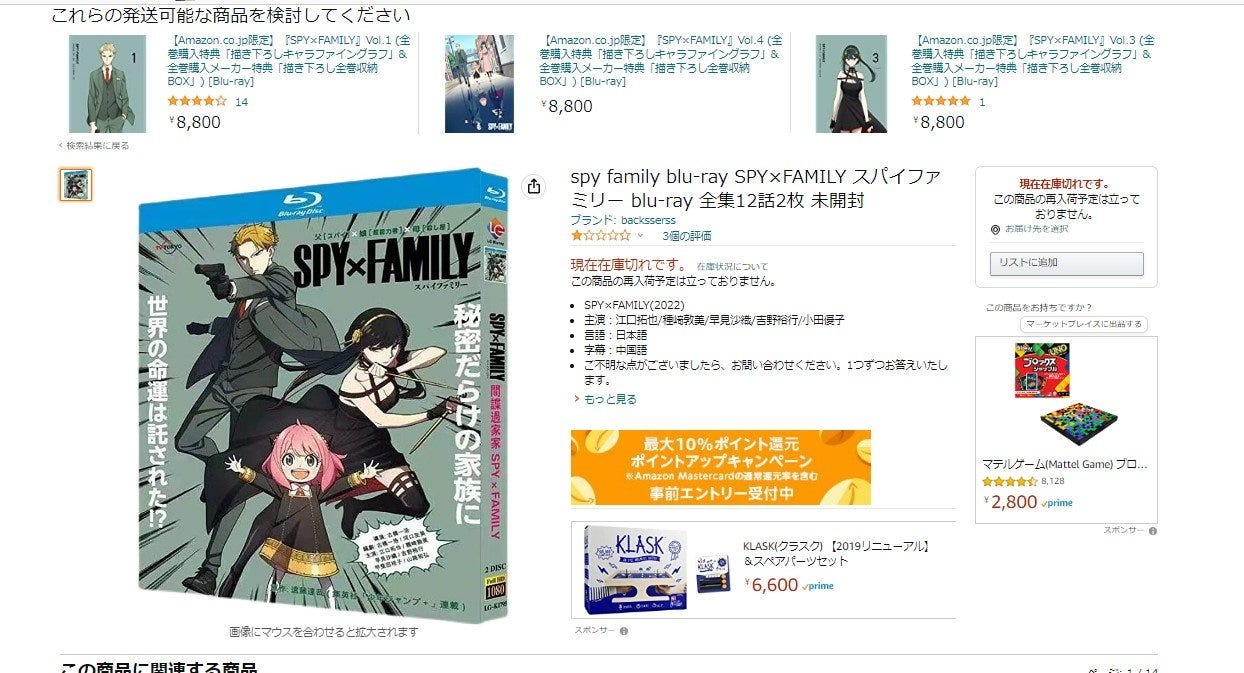
Sales of counterfeit anime and other character products caused ¥4.7 trillion (US$30.4 billion) in estimated financial damages last year, according to a content piracy survey commissioned by Japan’s Ministry of Economy, Trade, and Industry.
Why it matters: The figure represents the first measure of the impact of piracy on the market for Japanese entertainment merchandise, a key effort in the government’s goal to quadruple the overseas market for Japanese entertainment.
Some context: Previous editions of METI’s survey, conducted by advisory firm PwC Consulting on behalf of an anti-piracy trade group, the Content Overseas Distribution Association, only calculated damages from piracy using digital content.
In a 100-point action plan published in June, METI highlighted a need “to expand countermeasures not only for digital content but also for merchandise and other products that Japanese content companies rely on as sources of revenue”.
What’s happening: “Counterfeit goods are rampant, especially in online shops, and it’s difficult to crack down on them,” one anime licensor wrote in its response to the latest annual anime industry survey by the Association of Japanese Animations.
A separate survey by Internet monitoring firm Adish last year found at least 841 counterfeit anime merchandise with prices totaling ¥22.2 million (US$140,000) being sold online for five top anime airing in the second quarter of 2025.
Overseas licensees are attempting to combat counterfeit merchandise, but anime companies often lack sufficient chain of title documentation that allows them to submit infringement claims to these online shops.
By the numbers: Japan’s domestic market for anime merchandise grew 6.8 percent year-over-year in 2024, according to data compiled in the AJA survey, but results are mixed abroad.
“The anime video business seems to be doing well, but merchandise sales have been trending downwards since the COVID-19 pandemic,” the aforementioned anime licensor said. “Except for a few hugely popular top tier titles, most products aren’t selling.”
AI startup opens anime merchandise approvals platform
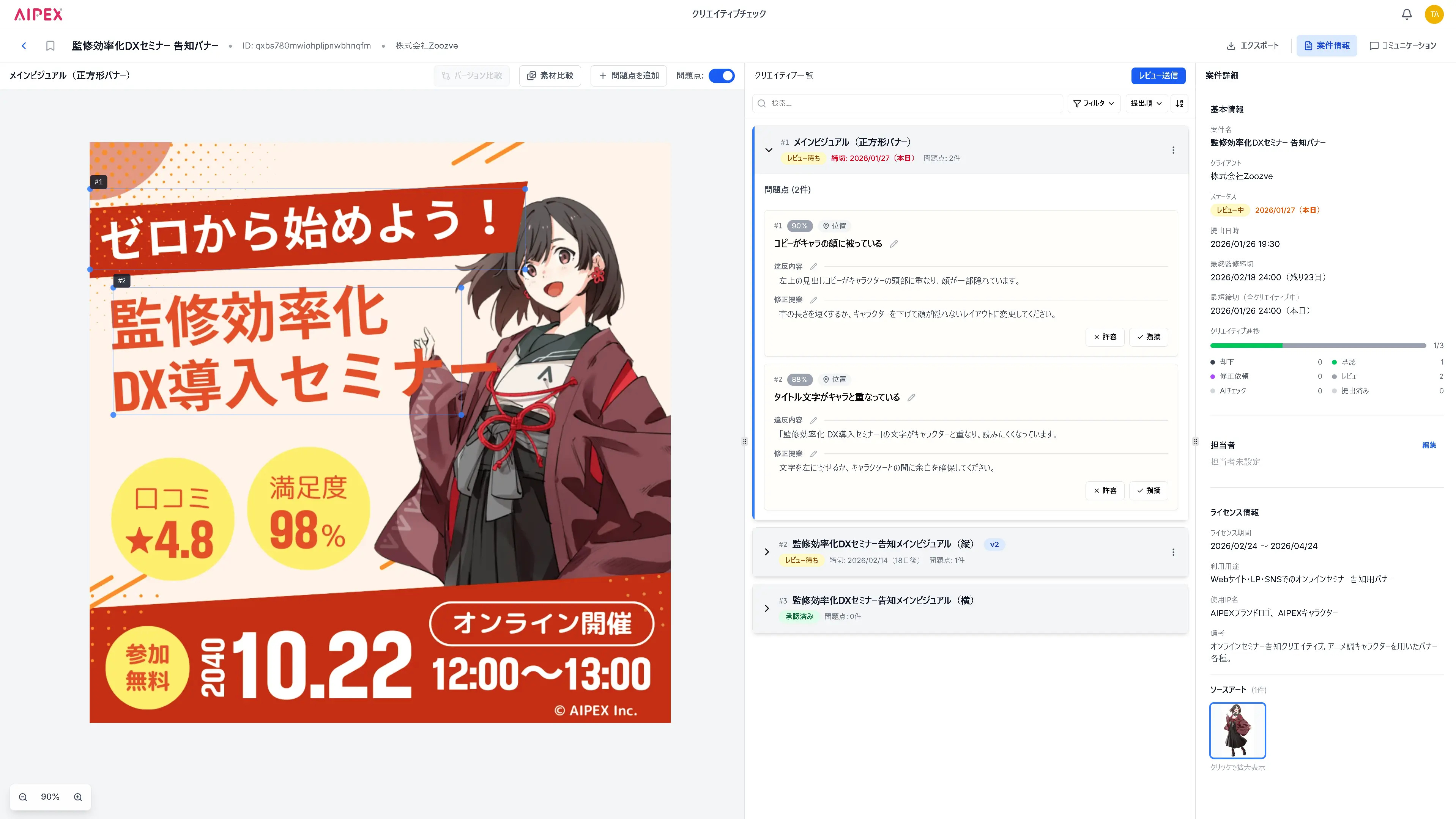
NTT Docomo-backed artificial intelligence startup AIPEX last week began operating an online platform that aims to speed up content licensor reviews of anime character illustrations to be used on commercial merchandise.
Why it matters: Anime merchandise availability remains a bottleneck outside Japan, and products are often delayed due to approvals that licensees must seek from anime licensors.
With more than 300 anime series aired each year, delays in merchandise reviews could mean licensees missing out on a title’s window of popularity.
How it works: AIPEX’s platform uses machine learning to check whether creatives submitted by licensees adhere to the original work’s worldview and character design rules, such as color schemes and settings.
When a creative is submitted, AI makes suggestions for revisions, which are then confirmed by a reviewer at the licensor before being sent to the licensee.
In demonstration experiments conducted by the company, AI was able to shorten the time of review by about 50 to 70 percent, the Nikkei reports.
What they’re saying: “We aim to promote [platform] adoption by publishers, game companies, and other companies that own IPs such as characters, anime, and manga, and to establish it as a standard supervision infrastructure in the licensing business,” AIPEX founder and chief executive officer Atsushi Oshiro said in a recent interview.
The company aims to sign on several dozen customers this year, according to the Nikkei.
Clippings: Aniplex buys Egg Firm anime planning firm

Aniplex acquired Egg Firm, an anime production planning company best known for managing the production of titles like The Disastrous Life of Saiki K., Mushoku Tensei: Jobless Reincarnation, and My Love Story with Yamada-kun at Lv999. (Oricon News)
Catch up quick: Egg Firm, founded in 2015 by a former producer from Genco, one of the first independent anime production planning companies, has grown rapidly in recent years thanks to a series of popular productions.
Egg Firm’s net profit has quintupled in the last five years, reaching ¥78.4 million (US$504,000) in the fiscal year ending in March 2025, according to the company’s financial disclosures.
Entertainment magnate Tatsumi “Tom” Yoda is stepping back from more than 20 years of leading film distributor Gaga, including two years of leading the company’s new anime and media business division. (Animation Business Journal)
Why it matters: Yoda, a co-founder of entertainment giant Avex and former chair of the Tokyo International Film Festival, led Gaga through a 2023 acquisition by amusement giant Genda and a pivot toward anime investments, culminating in a recent effort to enter direct anime film distribution in North America.
Crunchyroll’s viewership in Thailand has grown 50 percent year-over-year, leading the anime streaming service to increase investments with a new Thai-language user interface locally and dozens of new titles dubbed and subtitled in Thai. (Variety)
In the United States, Crunchyroll is increasing prices on all three subscription tiers, the first price increase since 2019 on the streaming service’s lowest tier and the first since 2024 on its two upper tiers.
Japan’s top anime films with more than ¥1 billion (US$6.4 million) in domestic box office earnings generated a cumulative ¥90.1 billion (US$578 million) in 2025, nearly 20 percent more than the previous record set three years earlier. (Toyo Keizai Online)
Fuji Media’s Pony Canyon anime and music production subsidiary reported its third straight quarterly operating loss through December 2025, attributed to a lack of hit anime titles and decreases in merchandise and live event sales. (Gamebiz)
NTT Solmare’s MangaPlaza digital manga service in the United States saw daily sales double immediately following last month’s closure of pirated manga and webtoon site Bato.to. (Content Overseas Distribution Association)
Popular anime Detective Conan is facing backlash in China over a collaboration with My Hero Academia, whose anime adaptation was removed from video platforms in 2020 over the controversial naming of a villain charater. (Kyodo News via The Mainichi)
Permanent ‘Sailor Moon’ stage musical sets April debut

A permanent Sailor Moon stage musical production will begin holding performances in April for the first time in six years, as its producer, Nelke Planning, seeks to capitalize on a growing interest in stage productions among foreign visitors to Japan.
Why it matters: Japanese stage productions typically run for only two weeks to one month, which means travelers often end up visiting during a period when there is no show running, a Nelke Planning producer told the Kyodo news agency.
By the numbers: Overseas visitors have made up about 10 percent of the audience at Sailor Moon musical performances in Japan, according to Nelke Planning.
Last year, the company brought the Sailor Moon musical abroad, performing Pretty Guardian Sailor Moon: The Super Live to sold out shows in the United Kingom, the United States, and China.
What’s next: Nelke Planning is taking over Club eX, a performance venue at Tokyo’s Shinagawa Prince Hotel, for almost daily performances of Pretty Guardian Sailor Moon: Shining Theater Shinagawa Tokyo starting in April.
Actors in two teams will perform up to three shows a day, currently scheduled through the end of July.
Nelke Planning had opened a popular Sailor Moon dinner theater in 2019, but that venue had to close in 2020 at the onset of the COVID-19 pandemic.
The bigger picture: As previously reported by Animenomics, the 2.5-Dimensional Musical Association, a trade group of production companies creating musical theater adaptations of anime, manga, and games, is also increasing support for performance ticket sales in English to attract more foreign tourists.
Animenomics is an independently run and reader-supported publication. If you enjoyed this newsletter, consider sharing it with others.
Looking forward to speaking with Richardson beginning at 8 am on Friday morning (JST). Please join us, if you can make it. There will be a recording, too.