


This is your weekly Animenomics briefing, covering the business of anime and manga. Today is Wednesday, July 1, 2026.
Programming note: This weekly briefing is going on a summer break for the rest of July after I return from Anime Expo. In the meantime, a series of insightful interviews that I’ve had in the backlog will take its place.
Aniplex posts record sales, but its anime studios suffer
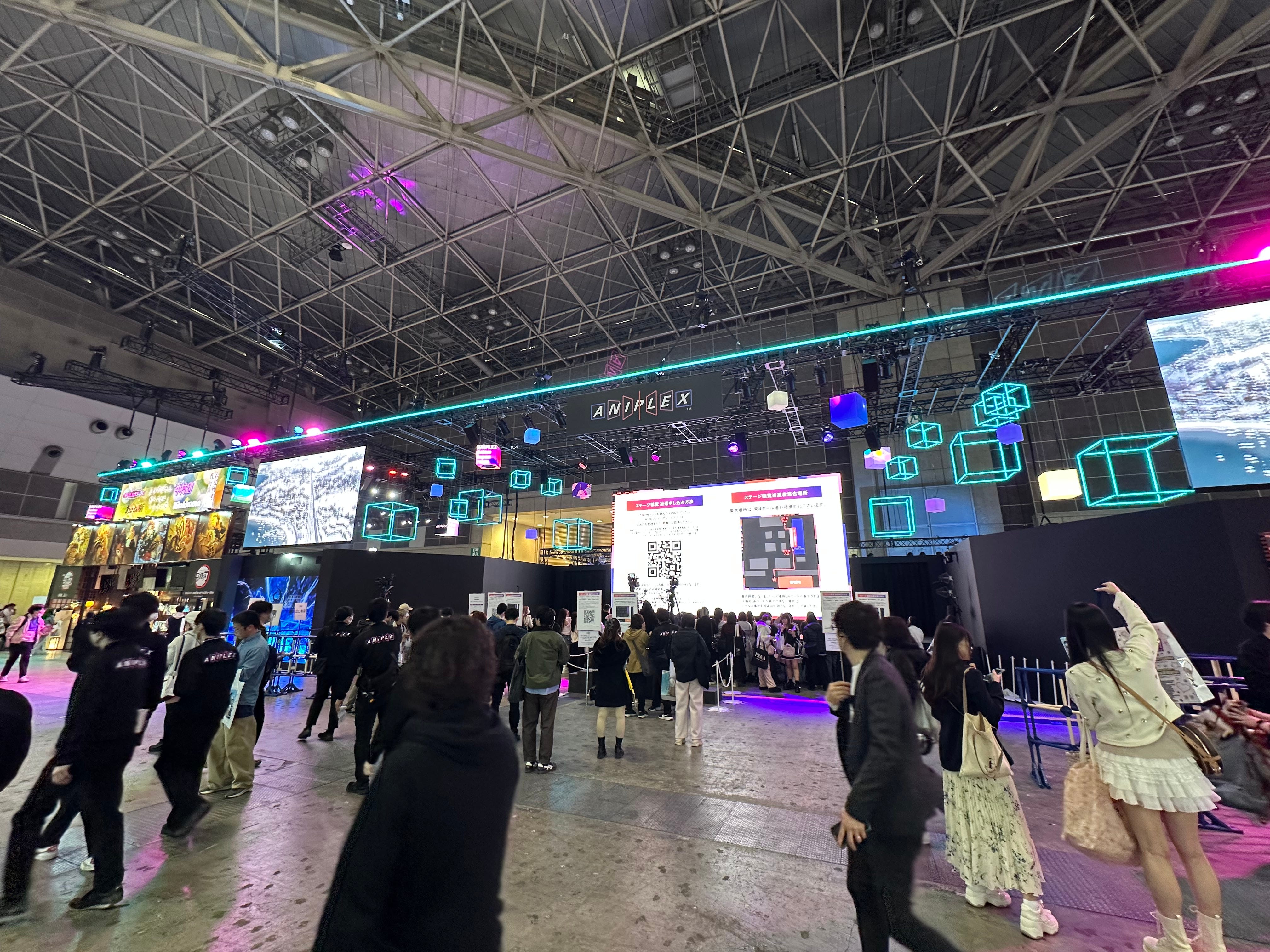
Sony Music’s anime production planning company Aniplex posted record net sales in the most recent fiscal year thanks in part to the box office success of Demon Slayer: Infinity Castle, but its affiliated anime studios are reporting mixed earnings results.
Why it matters: The earnings gap reflects an ongoing concern among anime industry observers where consolidation of anime studios results in the monopolization of profit by their parent anime rightsholding companies.
By the numbers: Aniplex’s net sales rose 45 percent in the twelve months ending in March 2026 to ¥212 billion (US$1.3 billion), while operating profit jumped 62 percent, according to an earnings announcement filed in the Japanese government gazette.
Aniplex had a blockbuster year with two investments—the first installment of the Demon Slayer: Infinity Castle anime film trilogy, which is Japan’s second highest-grossing film of all time, and Kokuho, Japan’s highest-grossing live-action film.
Fate Grand/Order, Aniplex’s highly successful mobile game, also celebrated its milestone tenth anniversary, leading to the gaming business performing above expectations, Gamebiz reports.
Yes, but: As previously reported by Animenomics, primary contractor studios like the ones Aniplex owns are facing shrinking profits from higher production costs.
Two subsidiary anime studios—Spy × Family co-production studio CloverWorks and 3D CG anime subcontracting studio Boundary—posted net losses for the year.
Solo Leveling anime studio A-1 Pictures posted a net profit, but that studio also saw a net loss in the previous year for the twelve months ending in March 2025.
Even live-action production firm Myriagon Studio reported a net loss despite its participation in the Kokuho production committee.
What we’re watching: Egg Firm, the anime production planning company acquired by Aniplex earlier this year, saw its net profit fall by more than 50 percent in the most recent fiscal year.
METI awards IP360 program subsidies for anime, manga
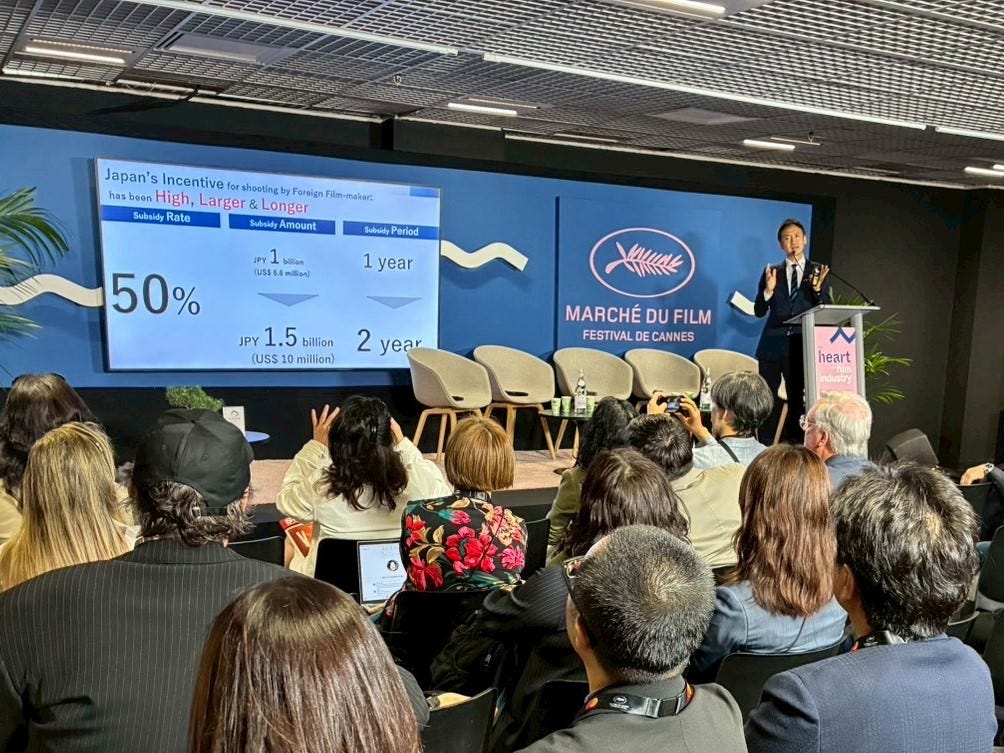
Japan’s Ministry of Economy, Trade, and Industry announced last week dozens of the first anime and manga production and promotion subsidies under its IP360 program, designed to triple anime and manga exports by 2033.
Zoom out: As previously reported by Animenomics, METI raised the floor and ceiling award amounts in an attempt to boost blockbuster productions and increase private sector investments in anime and manga.
Anime production subsidies of up to ¥1.5 billion (US$9.2 million) each were awarded to eight production planning companies and studios, focusing on theatrical releases.
Anime studios Wit Studio and Trigger are slated to create new anime films, while MAPPA will produce new anime titles targeted for the global market.
K2 Pictures, the film production and finance company by former Toei producer Muneyuki Kii, will create new anime films based on popular manga titles.
Aniplex, CoMix Wave Films, Twin Engine, and Production I.G will use the subsidies to improve anime planning and production processes.
Localization support worth up to ¥40 million (US$250,000) each were awarded to ten companies for projects that involve translation and cultural adaptation of anime and manga properties.
Award recipients for anime localization projects include short anime creator Plott, Shueisha-backed anime distributor Remow, Bushiroad’s upcoming BanG Dream! Ave Mujica film.
Manga localization project recipients include digital manga platforms Ganma! (operated by Comisma) and Comic Growl (Bushiroad Works) and an effort by manga publisher Bunkasha Publishing to translate manga in-house and distribute them for the North American market.
Content distribution platform investments of up to ¥3 billion (US$18 million) each were awarded to Crunchyroll, Bandai Namco and its North American toys subsidiary, illustrator platform operator Pixiv, and DeNA’s virtual YouTuber streaming app Iriam.
Subsidies were also awarded to expand digital manga platforms K Manga (from Kodansha), Manga Plus (Shueisha), Manga Up! (Square Enix), and MangaPlaza (NTT Solmare).
Software development subsidies worth up to ¥100 million (US$600,000) each were awarded to Sony Group and OLM Digital for in-house development of digital anime production software and to four platforms using artificial intelligence technology in anime and manga production.
Subsidies for anime and manga events worth up to ¥200 million (US$1.2 million) each were awarded to the Japan–China International Animation Film Festival, events held by Crunchyroll, a manga festival at Japan Expo Paris, and manga promotion at the Seoul International Book Fair and the Beijing International Book Fair.
Clippings: Kadokawa CEO survives shareholder vote
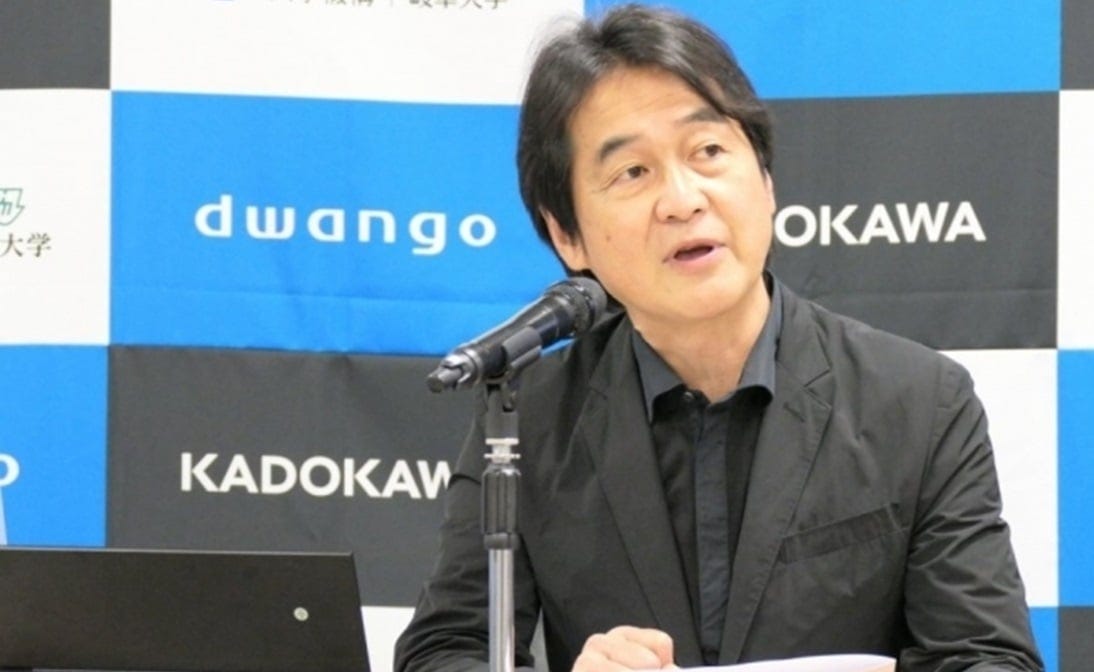
Kadokawa CEO Takeshi Natsuno survived an effort by Hong Kong-based hedge fund manager and activist investor Oasis Management to oust him from the position as the publisher seeks to reassure investors after disappointing year-end earnings. (Reuters)
Cool Japan Fund’s cumulative investment losses ballooned by 41 percent during the fiscal year ending in March 2026 to ¥54 billion (US$332 million), making it more likely for Japan’s government to abolish or consolidate the fund. (The Mainichi)
Bandai Namco is strengthening identity verification on its Premium Bandai online store for anime merchandise to combat a growing number of purchases made by people buying up limited edition items and reselling them at high prices. (Otaku Lab)
The Association of Japanese Animations and Tokyo Metropolitan Government plan to unveil on the sidelines of the Tokyo International Film Festival a new anime industry event to be held in 2027. (Tokyo Metropolitan Government)
Crayon Shin-chan fans from around the world are flocking to the city of Kasukabe in Saitama Prefecture, the setting of the manga and anime series. Foreign visitors more than quadrupled between the 2023–24 and 2025–26 fiscal years. (Nikkei Asia)
Stripe seeks to woo Japanese entertainment companies
“Many of our major domestic clients are gaming companies and media companies, and as this is currently the fastest-growing sector, our Japanese team is particularly strengthening its investments in this area.”
— Daniel Heffernan, Stripe Japan representative director
Context: Ireland native Heffernan, who became an anime fan through Love Hina, told the ITmedia Business Online outlet that financial technology firm Stripe sees an opportunity to win over Japan’s entertainment companies that want to take advantage of a new law on mobile app stores and avoid app store fees by establishing their own payment systems outside of the Apple and Google ecosystems.
Zoom in: Commenting on recent efforts by global payment networks like Visa and Mastercard to restrict payments for adult media in Japan, Heffernan says Stripe has no choice but to comply, but he points out the company also supports other methods of payment like JCB credit cards.
1 chart to go: Indian anime viewers prefer smartphones
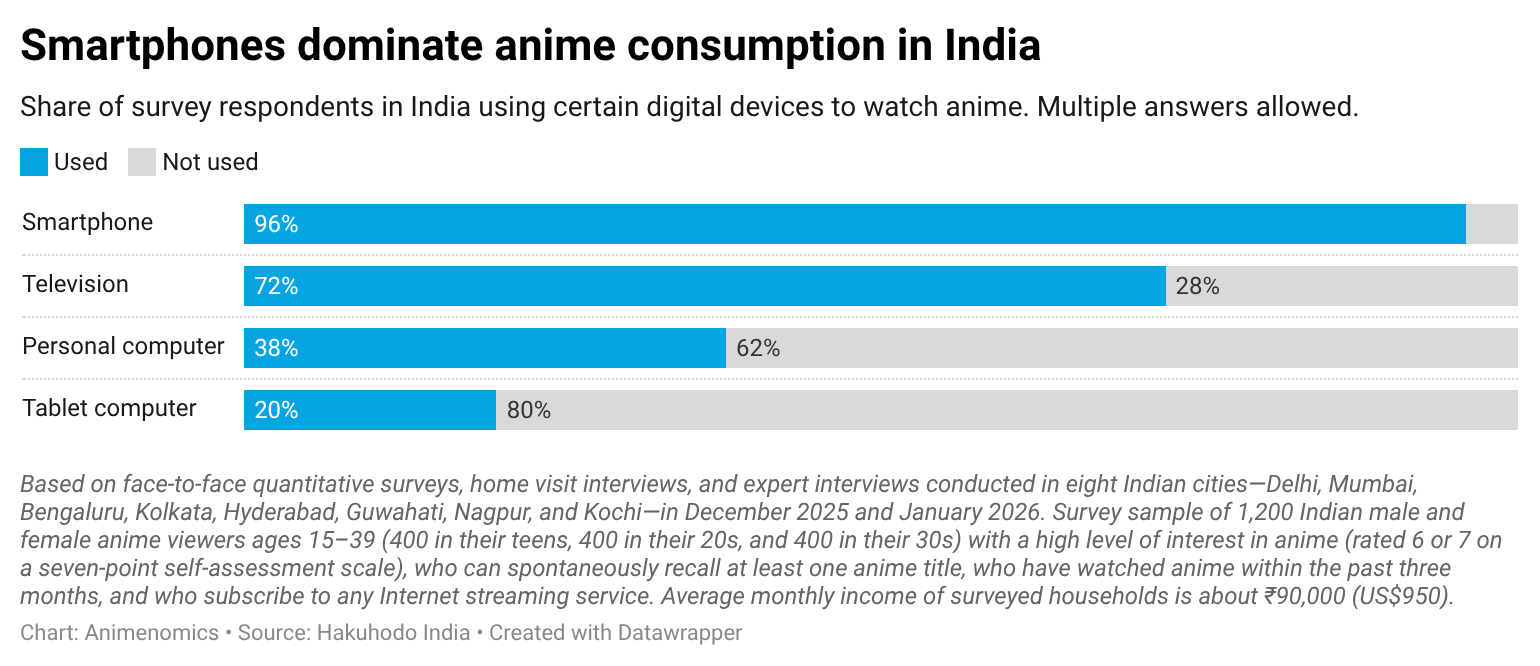
Smartphones are the most popular device for Indian viewers to watch anime, a survey organized by Hakuhodo India and conducted by Intage India found, demonstrating a mobile-first viewing culture in the country.
Why it matters: Smartphones also double as social communication devices, allowing Indian fans to quickly communicate with each other about their favorite anime.
Where things stand: Out of a sample of 1,200 respondents, 96 percent indicated that they watch anime on smartphones, while 72 percent watch it on television.
About 61 percent of respondents preferred watching anime that is dubbed into a non-Japanese language, while 35 percent favored subtitled content.
Dubbed anime viewers overwhelmingly prefer to watch in Hindi, while subtitled anime viewers prefer English subtitles.
The bigger picture: “According to interviews with multiple industry experts, India boasts approximately 150 million active anime users, ranking third globally in total viewing time and experiencing rapid growth of 16 percent year-on-year,” a Hakuhodo India researcher noted.
“The core audience consists primarily of people in their teens through thirties. […] The combination of a massive user base and high engagement demonstrates significant monetization potential.”
Animenomics is an independently run and reader-supported publication. If you enjoyed this newsletter, consider sharing it with others.
Reading about the financial status of anime studios made me think of the many CGI companies in Hollywood that worked with Marvel, and how Marvel just kept pushing for everything to get cheaper and cheaper, ultimately pushing many of the better companies out of business.
But what you're describing is something different, given that the studios are owned by companies like Aniplex. What are the practical implications for the members of the studio? If they are run as cost centers, that isn't necessarily a bad thing, right?
A killer edition. Have a blast at AX.
Re Aniplex operating revenue and profits. Cloverworks, while posting a loss is not in danger of bankruptcy surely? They’re essential to the Aniplex content funnel. Why would Sony let a studio that delivers premium content that they and their subsidiaries derive so much value from fail? Fans shouldn’t read too much into the earnings reports for any Aniplex owned studio. It’s just an accounting exercise.
What I think is interesting is that the studio that is by far the most important within the Aniplex ecosystem is Ufotable. A studio they do not own, but which they pay out hefty back-end percentages to on Demon Slayer’s anime derivative copyright. They must be coining it.
It makes business sense for Aniplex’s own studios to make a loss. Better for the balance sheet.