


This is your weekly Animenomics briefing, covering the business of anime and manga. Today is Wednesday, March 11, 2026.
In case you missed it: Today marks 15 years since the earthquake and tsunamis that struck Japan’s Tohoku region. To commemorate this anniversary, I have unlocked the paywall on a piece I wrote two years ago reflecting on the role anime studios play in disaster recovery.
Anime shift from home video to streaming accelerates

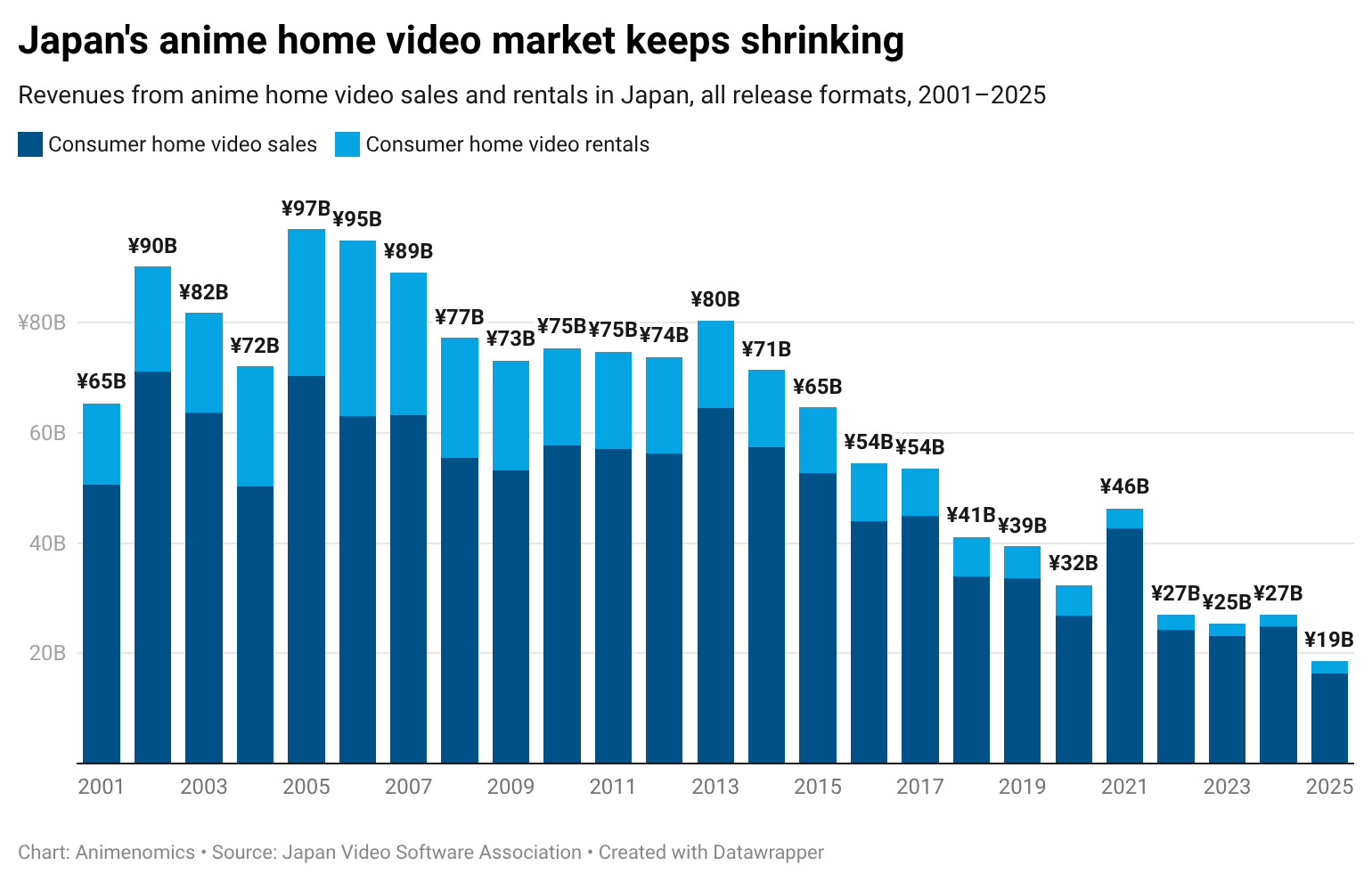
Japan’s domestic anime home video market shrunk by a stunning 31 percent in 2025 to ¥18.7 billion (US$118 million), according to the latest annual survey of home video sales and rental data conducted by the Japan Video Software Association.
Why it matters: Japan’s domestic anime home video revenue is now less than one-fifth of the size at the market’s peak in 2005, before the DVD bubble burst, as anime consumption shifts to streaming video.
By the numbers: Anime home video sales fell by 34 percent to ¥16.3 billion (US$103 million), the fastest rate of decline going back at least 25 years, with the exception of a 2022 post-pandemic market correction.
Unit sales fell more than 36 percent to 2.3 million units, about half of the number of Blu-ray and DVD discs sold in 2020.
Revenue from anime home video rentals, on the other hand, posted its first gain in nearly 20 years, rising 7.8 percent to ¥2.35 billion (US$14.8 million).
Zoom in: Among members of the JVA, anime revenue earned from streaming video on-demand services is up 48 percent from 2024 and is now 2.4 times the figure from 2021.
When anime Blu-ray and DVD discs are still being produced, manufacturers are packing in more episodes per release, pushing up the average sales price per unit sold by 35 percent over the last decade.
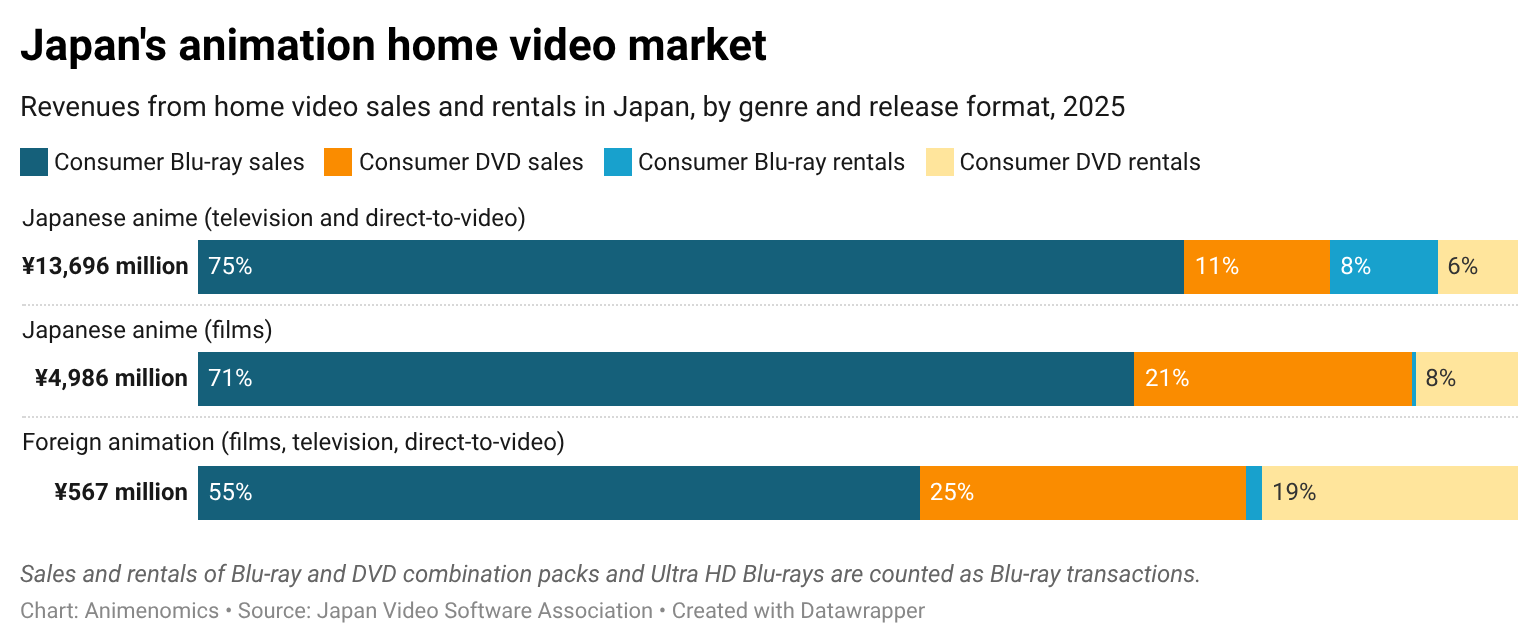
Between the lines: Due to the disappearing market for anime for children below ten years old, since last year the JVA has reorganized its animation home video categories to no longer be based on target age demographic.
Starting from the 2025 edition, sales and rental data categorize works by original medium, such as television, direct-to-video, or film.
Asahi Broadcasting anchors 3-year growth on anime IPs
Osaka-based commercial broadcaster Asahi Broadcasting Group will invest ¥8 billion (US$51 million) in anime production over the next three years, aiming to join at least 15 anime production committees, in a bid to grow its content rights business.
Why it matters: Asahi Broadcasting is Kansai region’s largest television network, but, like its peers in Tokyo, it expects revenue from broadcasting to decrease, and future growth will have to come from rights sales of titles in its media catalog.
Catch up quick: In order to chase anime growth outside Japan, the broadcaster has invested in international co-productions like Death Stranding: Mosquito, based on the franchise by renowned video game creator Hideo Kojima.
Asahi Broadcasting partnered with Hollywood production studio Line Mileage and is animating Death Stranding: Mosquito at an in-house studio formed in 2020.
It’s also partnering with acclaimed anime studio Kyoto Animation, also based in Kansai, on adaptations of the manga Sparks of Tomorrow and RuriDragon.
Yes, but: As a regional company, Asahi Broadcasting faces stiff competition for top-tier content from Tokyo’s commercial broadcasters, which have national reach.
Revenue forecast for sales of all types of content, including anime, for the fiscal year ending in March 2026 is currently about 10 percent lower than the original goal set in 2021.
What we’re watching: Asahi Broadcasting is showing interest in acquiring companies outside Japan to grow its overseas anime business.
It has already set up office in Shanghai to organize events and boost merchandise sales in China, and it plans to enter into anime merchandising in North America.
Clippings: Kadokawa consolidates anime studio offices

Kadokawa is consolidating five anime studios and back-office support departments, totaling 400 employees, into an office space in Ikebukuro’s Sunshine City building this fall as it looks to strengthen studio recruitment and talent development. (Press release)
The move comes one year after Kadokawa named a dedicated executive to lead the company’s anime studio business.
Operational consolidation doesn’t involve Doga Kobo and Kinema Citrus, which remain standalone, independent studios.
Berserk manga’s English-language volumes published by Portland, Ore.-based Dark Horse Comics have now sold more than 10 million copies, accounting for one in seven Berserk manga volumes in circulation globally. (Hakusensha)
Zoom in: As previously reported by Animenomics, Dark Horse’s first hardcover deluxe edition of Berserk was the top-selling manga in the United States in 2024, Circana BookScan sales data show, despite having a sticker price of US$49.99.
Plush toy maker SK Japan saw its market capitalization double to ¥15 billion (US$95 million) over the course of last year as earnings rose with growing demand for plush character merchandise at claw machine arcades. (The Nikkei)
Webtoon Entertainment elevated strategy chief Yongsoo Kim, whom Animenomics interviewed last year, to president overseeing global innovation and growth initiatives at the South Korean-owned digital comics company. (Variety)
Saudi Arabia’s Manga Productions and Manga Arabia were named joint grand prize winners in the Cool Japan Public–Private Partnership Platform’s annual awards gala for their efforts to distribute anime and manga in the Middle East. (Gamebiz)
British auction house Christie’s will hold its first anime and manga auction in New York next week, pairing collectibles from the media with historical and contemporary Japanese art pieces. (Observer)
Kadokawa looks to writers abroad to grow light novels
“I don’t feel like there’s a shortage of Japanese authors in light novels. If anything, their numbers are increasing. On the other hand, the readership is declining. Looking back at the history of light novels, just like how the boom of anime based on light novel was followed by hit adaptations of web novels, I believe the market needs a new spark.”
— Satoshi Arima, MF Books editor-in-chief, Kadokawa light novels and new literature department
Context: Arima, who recently led a global contest for aspiring light novel writers at Kadokawa, told Otaku Lab in an interview that readers in their 50s and 60s are the most enthusiastic buyers of light novels in Japan. This demographic drove the light novel sales boom of the last decade, prompting publishers to commission manga adaptations and eventually anime adaptations when titles sell well.
Because the contest was limited to works written in English, it attracted writers from outside Japan, many in their 30s, which Arima hopes will spur on writers at home to innovate and bring the domestic light novel market back to growth.
Popular folklore anime revived for new young viewers

Animax Broadcast Japan will begin rebroadcasting Traditional Japanese Folktales on the Kids Station satellite television network later this month, more than 30 years after the beloved anime program ended its broadcast.
Why it matters: Traditional Japanese Folktales, which first aired in 1975, is one of the longest-running anime programs in Japan and has aired in several European countries in the past.
At its peak in the 1990s, domestic viewership reached 21 percent of households in the Tokyo region and 18 percent of Kansai region households.
Where things stand: Rightsholder Ai Kikaku Center plans to revitalize the property and reintroduce it to a new generation of young viewers for its 50th anniversary.
The anime’s film footage and original drawings were retrieved from warehouses, where they laid dormant for decades, and all of the nearly 1,500 episodes in the series are being digitized.
The firm is now seeking corporate partners that can help it create new products and services based on the anime.
The intrigue: Ai Kikaku Center is using AI technology to create new foreign language dubs while retaining the voices of narrators Etsuko Ichihara and Fujio Tokita, who died in 2019 and 2018, respectively.
Animenomics is an independently run and reader-supported publication. If you enjoyed this newsletter, consider sharing it with others.