


This is your weekly Animenomics briefing, covering the business of anime and manga. Today is Wednesday, April 15, 2026.
In case you missed it: Demon Slayer: Infinity Castle’s first anime film ended its run in Japanese cinemas, finishing in second place in all-time domestic box office rankings with ¥40.1 billion (US$252 million) in revenue, behind Demon Slayer: Mugen Train.
Permanent work arrangements rising among animators
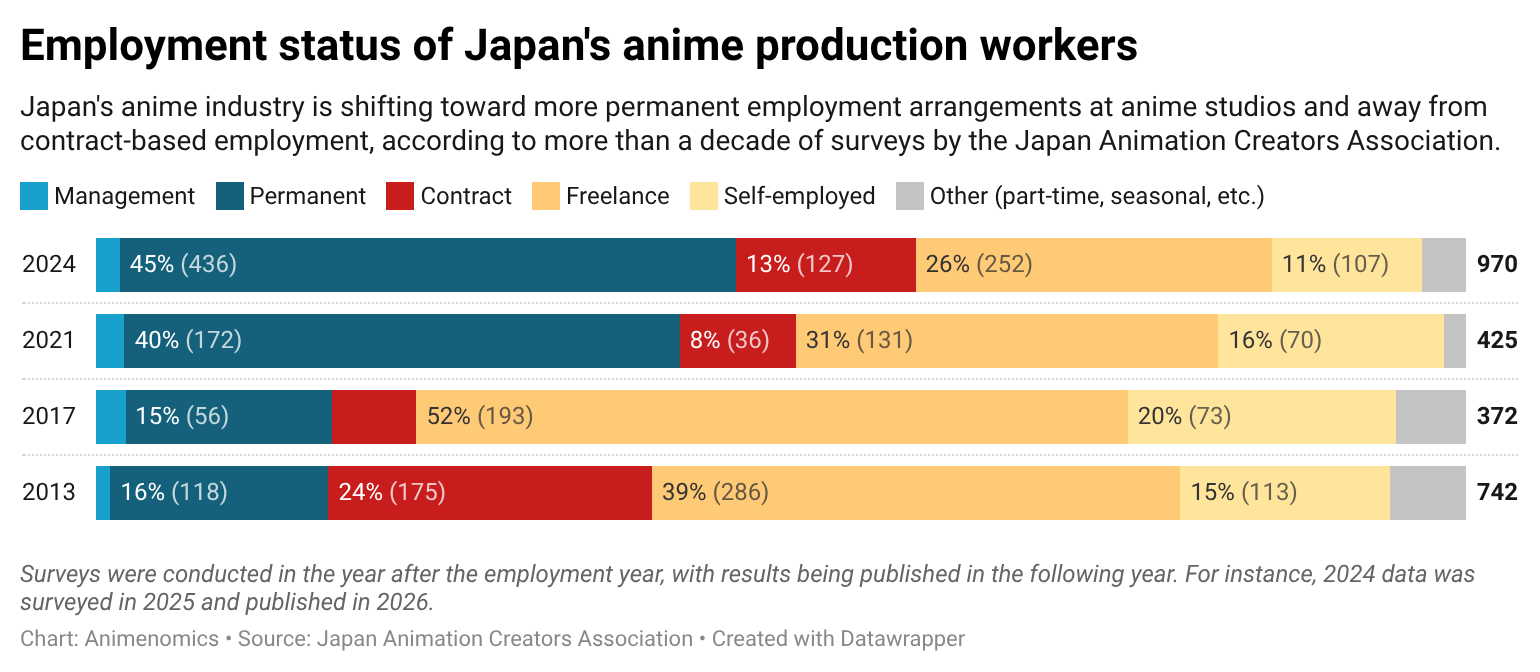
Employment at Japan’s anime production studios is shifting away from freelance and contract work and toward full-time salaried roles, according to newly published survey data from the Japan Animation Creators Association, a labor advocacy group.
Why it matters: JAniCA’s survey results are reversing an often-repeated narrative that the anime industry relies mostly on freelance animators as anime studios try to secure reliable talent during the anime industry’s persistent labor crunch.
The most recent survey, which was conducted at the end of last year and details working conditions in 2024, had the highest level of participation in a decade.
By the numbers: One in two survey respondents worked in anime in non-permanent employment arrangements in 2024 (defined as contract workers, freelancers, or self-employed subcontractors), down from three in four in 2013.
About 47 percent of survey respondents had salaried roles in 2024, up from just 17 percent in the 2013 survey results.
Even among non-permanent workers, two out of three respondents report having a contract that partially or fully binds them to working with a specific employer in exchange for a retainer fee.
Zoom in: Increased availability in permanent work arrangements with standard hours has led to significant improvements in animator working conditions in the last decade.
Average working period per month among respondents has fallen to about 190 hours (44 hours per week) in 2024 from 262 hours (60 hours per week) in 2013.
Median annual earnings stood at ¥4 million (US$25,000), down five percent from 2021—likely attributable to a decrease in the average years of experience among respondents—but still significantly higher than ¥3 million (US$19,000) in 2013.
Reality check: Animators still encounter high levels of stress at work despite better working hours and earnings, with 57 percent of respondents saying that work stress has affected their personal lives.
Just below half of survey respondents felt a sense of security in their current job, and just 38 percent would recommend their current work environment to friends and colleagues.
Consumption tax reform impact on anime labor limited
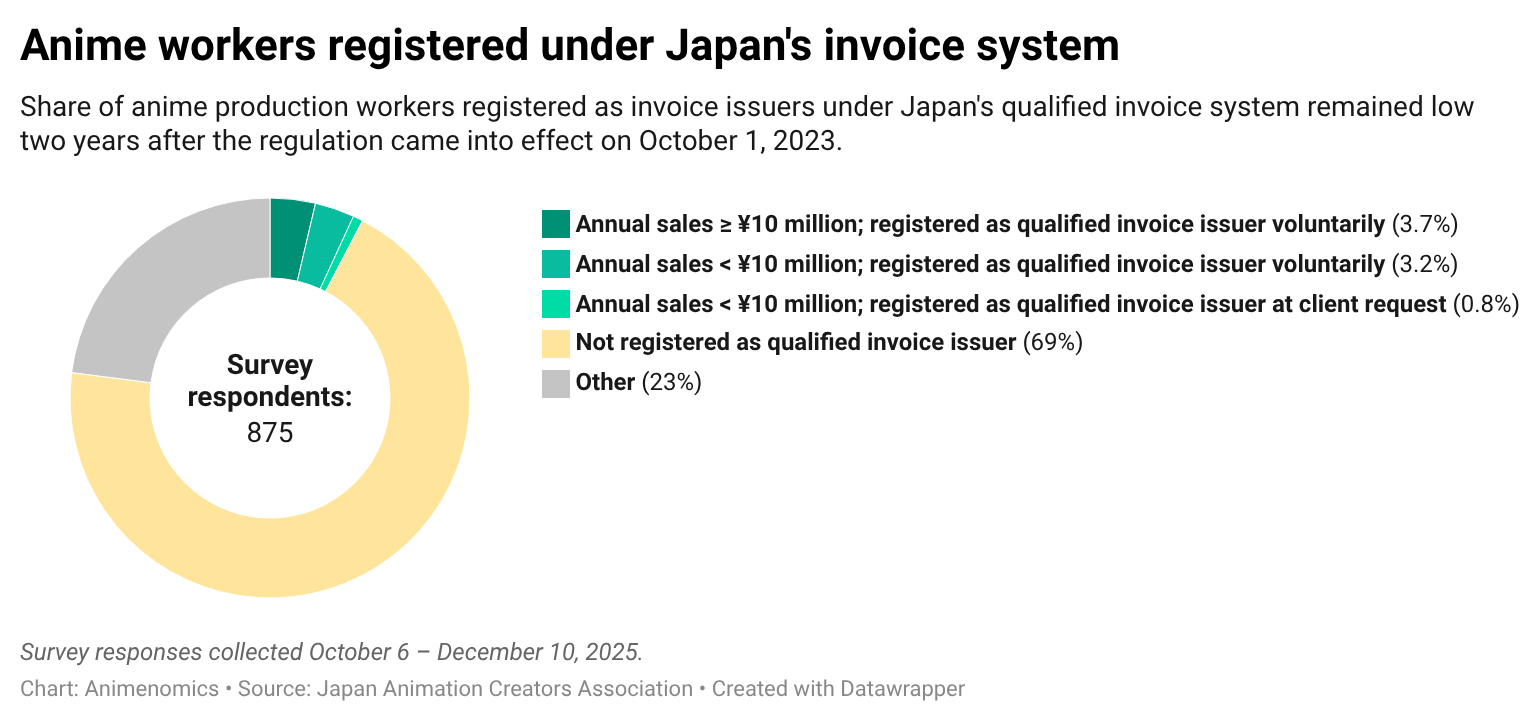
Two years after Japan’s new consumption tax reporting requirements came into effect, the changes haven’t impacted the anime labor market as broadly as activists originally feared, according to a Japan Animation Creators Association survey done last year.
Why it matters: Activists who fought the so-called invoice system’s implementation feared that as many as 30 percent of anime workers could go out of business from the tax increase and additional administrative burden.
The new rules will phase out by 2031 a consumption tax exemption for businesses with annual sales of less than ¥10 million (US$70,000), including freelancers and self-employed workers, that has been in effect since 2004.
Where things stand: In a survey of nearly 900 anime production workers, just eight percent of respondents indicated that they have registered as invoice issuers to report consumption taxes.
The findings suggest that, for now, anime production studios are more likely to assume the tax burden of its freelance and self-employed workers and maintain the status quo amid struggles to recruit and retain skilled talent.
As previously reported by Animenomics, a 2024 survey by the Teikoku Databank credit reporting agency found that most anime studios still employed freelance workers a year after the new rules came into effect.
With anime studios increasingly hiring workers in permanent work arrangements, there could also be fewer freelance animators that would need to register under the invoice system in the future.
Yes, but: It’s also clear that among the workers who have registered as invoice issues, three in four have seen increased administrative work such as hiring accountants and purchasing and using accounting software.
What we’re watching: The next transition starts this October, when the amount of consumption tax that can be exempted falls from 80 percent to 70 percent, increasing the burden on businesses.
Clippings: Toho reports record revenue and net profit
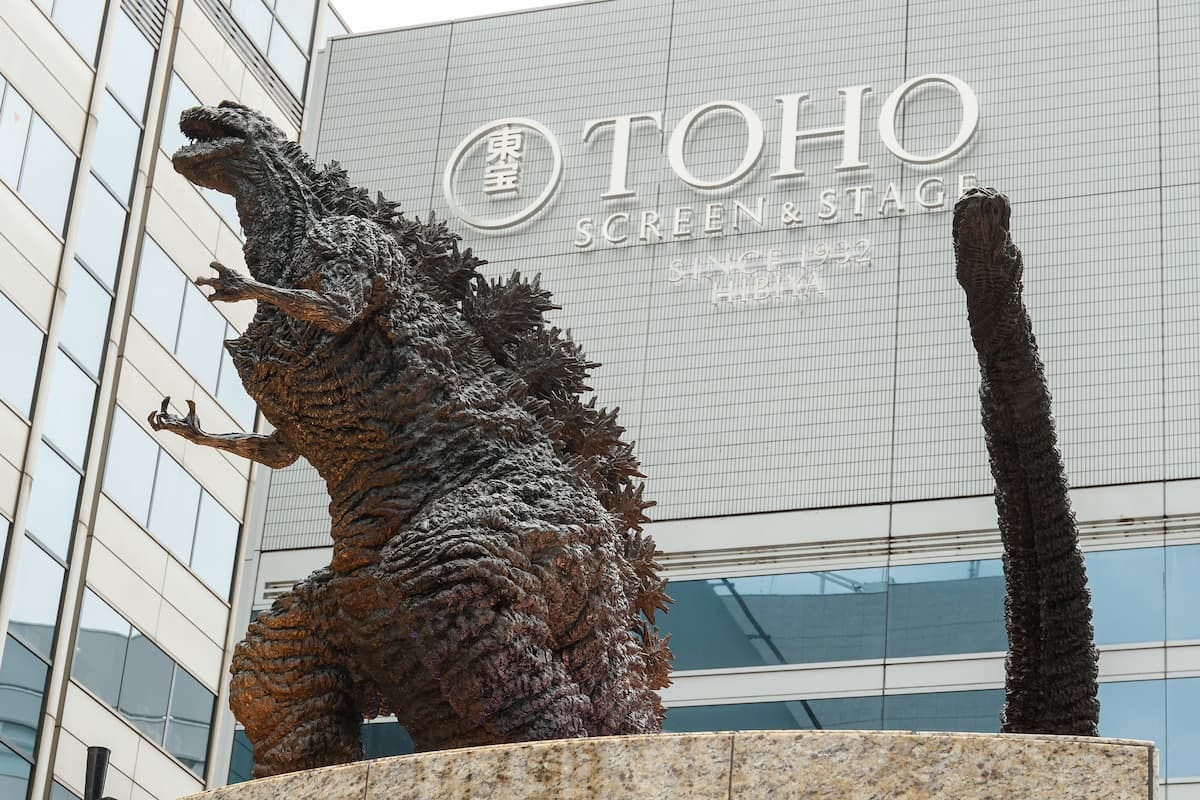
Toho reported record sales and net profit for the fiscal year that ended in February, driven by the box office successes of the Demon Slayer: Infinity Castle film trilogy’s first installation and live-action blockbuster Kokuho. (The Yomiuri Shimbun)
Blockchain startup Gaudiy, which owns the anime and manga community platform MyAnimeList, has received investment from Toei Animation and film distributors Toho and Shochiku. (Press release)
Los Angeles-based Tokyopop is seeking to raise up to US$1.2 million through sale of public stock as the manga publisher aims to more than triple its annual revenue to US$50 million by 2030. (Anime News Network)
Dai Nippon Printing is launching simultaneous anime and manga merchandise sales events in its retail stores in Tokyo and San Francisco to strengthen the distribution of official merchandise in the United States. (Press release)
Crunchyroll Manga will launch service in India within 2026, says Crunchyroll India marketing director Akshat Sahu, as the company seeks to promote legal means to read manga in the country. (Courrier)
Hokkaido’s New Chitose Airport is seeking to attract tenants specializing in anime and game merchandise to fill 20 vacant retail spaces in a concourse that connects the airport’s domestic and international terminals. (The Nikkei)
Netflix is sponsoring an “anime peace studies” course at Tokyo’s Keio University that will discuss anime’s soft power effects in Asia and Latin America and how the media affects international exchanges with Japan. (ITmedia News)
Broadcasters prioritize anime shows in 11:00 pm slots
“I believe it’s important to take our programming a step or two further than other networks, such as creating broadcast slots that air anime closer to prime time [7:00 p.m. to 11:00 p.m.], to demonstrate to the original creators and publishers that TV Tokyo as a company is fully committed to anime productions.”
— Hiroshi Yoshitsugu, TV Tokyo president and chief executive officer
Context: Yoshitsugu, speaking to Japanese media during a regularly scheduled press conference earlier this month, growing competition for original intellectual properties is pushing broadcasters to open up earlier time slots in their airing schedules to more anime titles.
As previously reported by Animenomics, TV Tokyo had aired the highly successful Spy × Family in an 11:00 p.m. time slot during its 2022 debut, and more networks have been moving up anime broadcasts to that time slot in recent years.
Bandai Namco Ent. launches ‘The Idolmaster’ in English

Bandai Namco Entertainment has opened an English-language social media channel for the idol production video game and anime franchise The Idolmaster ahead of its voice actors’ performances at the Anime Central fan convention in Chicago in May.
Why it matters: The Idolmaster generates more than ¥70 billion (US$440 million) in revenue annually, spanning games, anime, music, live events, and merchandise, but the IP’s presence has largely remained limited to Japan and certain East Asian markets until now.
The last large-scale The Idolmaster performance in North America was in 2018 on the sidelines of Anime Expo in Los Angeles.
What’s happening: As The Idolmaster celebrated its 20th anniversary last year, Bandai Namco showed interest in growing the franchise’s footprint both at home and abroad.
“We will continue to value existing works while creating more and more new games. At the same time, we will expand various businesses to share the appeal of The Idolmaster series not only in Japan but in various regions around the world,” series head coordinator Koji Hatano said in the company’s annual report last year.
Last month, Bandai Namco Entertainment printed an advertisement in the Nikkei, Japan’s largest financial newspaper, seeking private sector and local government partners interested in licensing The Idolmaster characters.
Zoom out: Increased licensing opportunities for The Idolmaster franchise is part of Bandai Namco’s plan to invest in the growth of its IPs through the fiscal year ending in March 2028.
Animenomics is an independently run and reader-supported publication. If you enjoyed this newsletter, consider sharing it with others.